Thursday, June 28, 2012

Solaiemes attended Mobile Asia Expo in Shangai.

Solaiemes attended past week Mobile Asia Expo, hosted in Shanghai. This is the new name and venue for the now traditional Asia-focused GSMA event, taking over from Mobile Asia Congress that we also attended in previous years in Hong Kong and Macao. This year, the event was opened to the "pro-sumers" and as a result, attendance was much higher than in previous editions. Many companies focused on consumer products, a developer area, and a gaming zone attracted many visitors. Solaiemes participated in the Joyn area, inside GSMA Pavillion, together with a number of companies in the Joyn/RCS ecosystem, not only presenting our demos to operators, but also introducing Joyn to a fairly large number of visitors not directly related to the telco market.


The event was a very good opportunity to engage with the rest of the ecosystem, share experiences, strenghten partnerships and get first hand knowledge of the dynamics and trends in the Asia regional markets, very diverse between themselves and quite different from Europe. Just an example: South Korea already offers nationwide LTE coverage, has 14% of the customers using LTE and it is forecasted that 50% customers will use LTE in less than one year.

Already talking with a number of service providers in the region, Solaiemes is looking forward to partnering with operators and vendors exploring monetization strategies for IM services, very popular in many markets in the region. We can say we come back with several new open opportunities in the suitcase. Jose Recio


Wednesday, June 20, 2012

How WebRTC will empower RCS-e/Joyn. Demo.

Lastly we are reading discussions about considering WebRTC as a threat for the telcos. We want to demonstrate the opposite. If telcos deploy the FTB (REST Exposure of its enablers as voice, RCS-e), allowing to create thin clients endpoints of its enablers. then telco communications will become ubiquitous and fully multimedia.
See our demo: adding to our RCS-e Web Client powered by RCS-e Thin Client Server and RCS-e LiveServe REST API the WebRTC webkit by Ericsson just for this demo purpose.
In the next future we may expect that all web browsers will support natively WebRTC, and great communicators will be feasible. It means a huge opportunites for the ones having a great core and services.


Thursday, June 14, 2012

We attended the VMA conference

We attended the past 3 days the VMA (Voice & Messaging Association) conference in Madrid. Many representatives from telcos, network equipment vendors and also start-ups were there discussing about current and coming trends in voice and messaging space.
Particulary interesting  were the keynotes by telco representatives including Joyn/RCS-e as call completion alternative channel. We idenfied the immediate application of Joyn to the visual voice mail space.
Also, Ronald Gruía, a Frost&Sullivan analyst,  pointed that innovation is not coming from telcos or the big NEVs but the start-ups. Also he explained that telcos should evolve but can not try to become the same of internet companies as the business models are different.
I would add: telcos! evolve your soul, do not kill it.

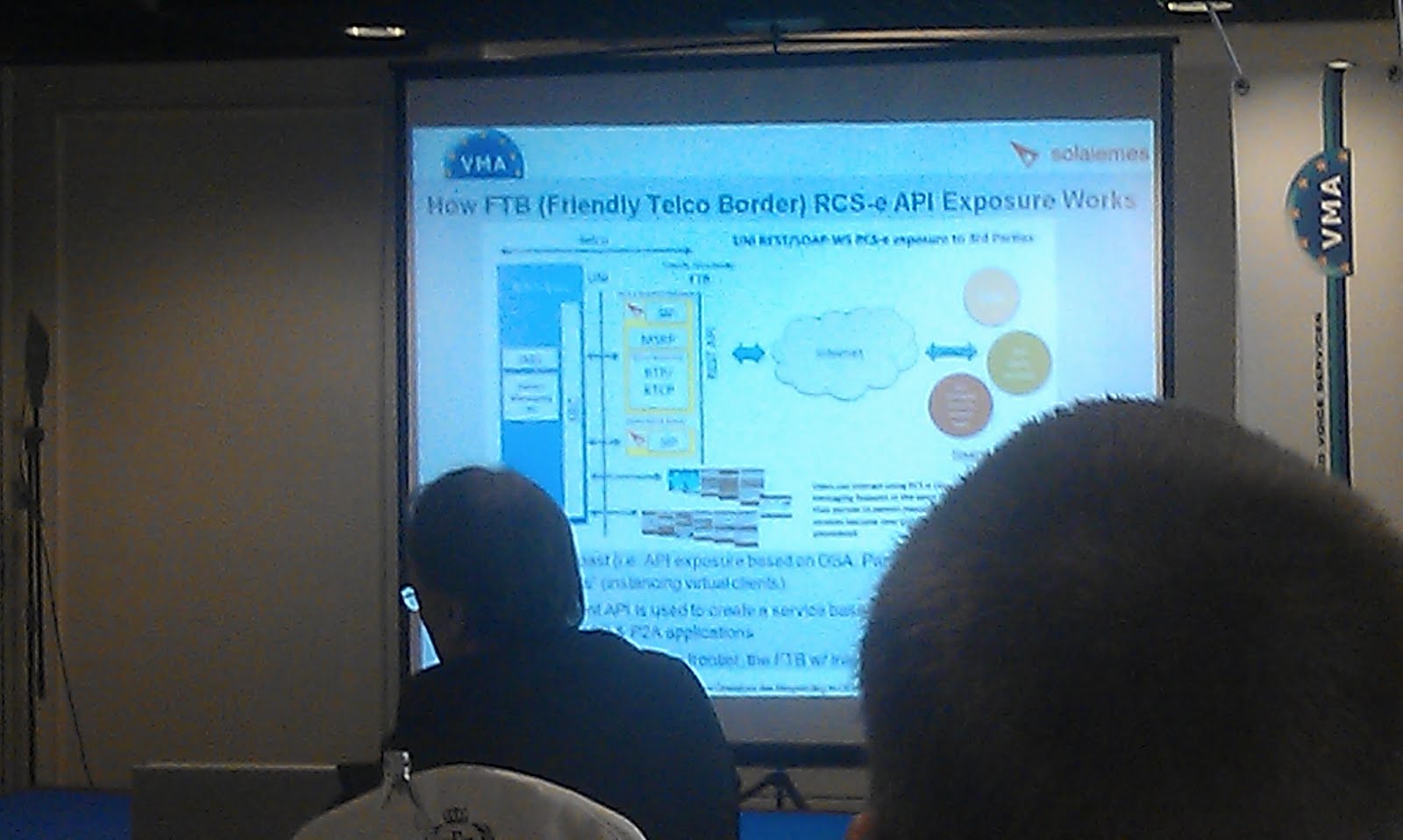
We could pitch during the innovation contest explaining the FTB and how the RCS-e REST API exposure works and how it enables RCS-e/Joyn to become a service platform.
Congrats to the winner, a spanish startup Mobbeel developing amazing biometric technology for mobile services authentication.

It was a great conference with a great networking, thanks for the invite !!!


Wednesday, June 6, 2012

RCS-e/Joyn VideoShare divert demo.

Just a 1 minute videodemo of a new feature of our RCS-e Personal Manager IMS Application Server. The new feature is the videoshare divert: the user can configure other Joyn identity to receive the videoshare when not answering, rejecting, or by default (could be different ones). In the demo we used the "reject" to divert the videoshare to a third mobile phone.


It proves how flexible the telco communications can be, how the telco can provide freedom to the user, and how the imagination finally gives content to the IMS.
Can you imagine RCS-e over LTE with HD videoshare, and you at home rejecting the stream to just divert to a Smart TV thin client in a huge flat TV? Stop imagining, the future just arrive.

Credits:
Application Server: Solaiemes RCS-e Personal Manager
Also used in this demo for the e2e:
IMS: OpenIMS
RCS-e client: Orange RCS-e SDK (with Solaiemes UI)


Tuesday, May 29, 2012

Solaiemes RCS-e API technology compatible with Newpace RCS-e core solution

We are glad to announce the compatibility between our RCS-e 3rd party REST API Exposure technology with the Newpace RCS-e Core.

The Solaiemes RCS-e 3rd party REST API Exposure technology was tested with the Newpace RCS as a Service product core. When combined, these two products provide operators’ an RCS-e in the Box solution with an RCS REST API exposure that allows our customers to create third party services and web access clients on top of NewPace’s hosted RCS-e/joyn services seamlessly.

Newpace RCS-e as a Service (hosted) allows telcos to deploy RCS-e/Joyn minimizing the CAPEX investment. Solaiemes platforms can be also offered "as a Service"(link), making feasible for MNOs to deploy in a very short time RCS-e service with additional services as web access and 3rd party services on top of the basic Joyn services created with REST API.

We are putting the each one innovation overcoming the issues (or myths) that stopped RCS-e deployments:

- No need of a full IMS draining CAPEX budget.
- Having from the beginning a platform for innovations by 3rd parties (CRM services, internet mashup, user generated content in social media using Joyn features from your phonebook, etc).
- Affordable alternative for MVNO's and non tier-1 MNOs to launch RCS-e with a minimum investment and no risk.

For us it is important proving that vendors are cooperating to help telcos to deliver the next big thing in messaging and add value to the telco enablers.
(read the post by Newpace).


Thursday, May 24, 2012

Is "Solaiemes RCS-e REST API" Cloud based?

We are being asked whether the way we expose RCS-e capabilities as REST API is "cloud". Well, our platforms are instancing RCS-e Virtual Clients, behaving as "clients" and exposed to internet. In previous post we explain how our platforms installed in the MNO premises become an "extra mile" of their infrastructure, following the SBC. But it is not the only one possible way of using our infrastrucute. We may also install it directly in internet and the virtual RCS-e Virtual Clients (services or web clients) will be registering to the telco RCS-e via internet as device client does.

Even the MNOs are preferring to have "all what they consider infrastructure" in their datacenters, this Cloud based RCS-e API exposure is the way that we are currently providing remote demos and engagement/try&buy pilots, and the interoperation is very easy to the telco core, only need to know the IP Address of SBC or P-CSCF. Yes, it works. Also it has additional advantadges as RCS-e Solution Gateway and RCS-e Thin Client Server are multitenant and can instance RCS-e Virtual Clients in different MNOs/cores/domains. Yes, we need to be flexible and it allows to offer the RCS-e REST API exposure as a Service :-)


Right now, there are appearing vendors with a RCS-e Core as a Service solution (or RCS-e in a Box cloud based) as Newpace. Then it is possible partnering to create a bundle of RCS-e as a Service offering plus our Value Added Services and Thin/Web Client access on top of RCS-e enabling platforms. You can see the chart. It becomes a nice way to deliver #telcoOTT RCS-e with no CAPEX investment.
From the point of view of where our platform can run it is possible both, in dedicated servers, or in public cloud virtual machines, all combinations tested and working fine :-) Then, we can say that Solaiemes is a cloud communications infrastructure/service provider. Feedback welcomed.


Monday, May 14, 2012

Our views on CTIA Wireless 2012.

Last week we were in New Orleans exhibiting at CTIA and it was great. Perhaps it is true that CTIA is loosing some big exhibitors once NA & LATAM are opting for UMTS as 3G and LTE as 4G and then the MWC is becoming the main marketing event for big players.
Instead, CTIA had a lot of vibrant companies showcasing pure innovations, small companies delivering high end innovation to help carriers and delight users.
We focus our presence in evangelizing and explain why messaging (RCS, RCS-e, Joyn) must become a platform, not only a person to person messaging alternative to the existing ones.
We had very positive feedback about our Friendly Telco Border concept and how we apply it to RCS case by delivering REST API (easy to use for whatever non-telco aware developer) to create both: services and web/thin clients.
Several telcos agreed that they way to compete is exposing the telco enablers in the way it could be used by third parties and Parlay and face to face interoperations with core infrastructure are not the way. Several MNOs are waiting for first RCS-e live deployments and the availability or out of the box enabled device to start the proccess of launching: RFI, trial, etc but expecting that time to market will be less than 6 months as they will be deploying already interoperated technology and native clients. Crossing fingers then.
Finally we talk with other core vendors to partner in areas where we are clearly not overlapped but complementing and creating a powerful end-to-end.
Hope to tell you news about this point in the next weeks.


Wednesday, May 2, 2012

The way our RCS-e/Joyn REST API exposure works.

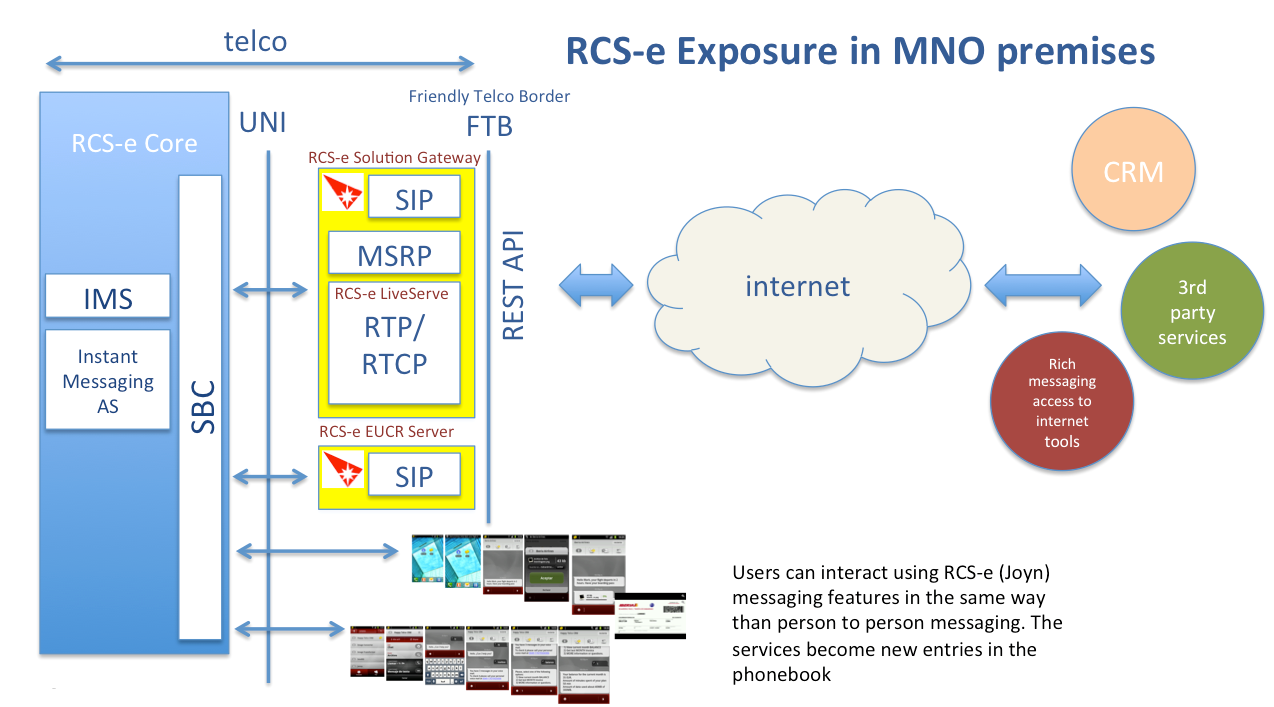
Solaiemes approach to the need of exposing carriers communication capabilities to 3rd parties was radically different to the previous ones. In the past, the attempts to expose capabilities to create services were based in OSA, Parlay, etc, more thought to offer professional services the own infrastructure vendors than a proper exposure to the vast ecosystem of developers. Our approach is simple, expose not directly from the core infrastructure but as "clients". We instance virtual clients (telco protocols of the clients being kept at carrier cloud) and in the case of our web-clients strategy. In this case the RCS-e Virtual Client API is not used to create an alternative UI in a device but to create a service based on messaging interaction (as it was done with SMS to create A2P and P2A cases).
The chart.

(click to enlarge)

We were awarded by this approach. As you can see, the 3rd party API is core vendor independent (no lock-in then), as it behaves as "client", we can say we are interoperated with the main vendors of IMS, Instant Messaging Server and the SBC leader. What we provide is that "extra mile" for telcos to create a new frontier, the one we name FTB (Friendly Telco Border). With our approach "plug & play" whatever RCS-e core can have integrated a 3rd party REST and SOAP WS exposure in less than a week and RCS-e automatically becomes a platform to create value added services (application to person and person to application) complementing the person to person messaging (initial use case). You can see in the chart how device clients interact with "service clients" representing services (i.e: CRM). Those "service identities" (additional contacts in the user phonebook) will be a new revenue stream for carriers, and if they are defined as SIP URI, also a new business model appears: the domaining based on the names of the services to be deployed. If we see how amazing companies as Voxeo, Twilio etc are succeeding "selling" communication capabilities, we see that they approach the developers/customers offering the interface they know how to use and needing none/minimum support: internet style APIs (REST & SOAP). Time for telcos to make their try in the way developers can embrace it :-)


Friday, April 20, 2012

Solaiemes to attend IMS World Forum 2012 and participate in a Panel.

We are attending the coming IMS World Forum 2012 next 24-16th April in Madrid organized by Informa Telecom & Media.
Juan Mateu will participate as panelist in the "Application developer showcase - Evaluating IMS as an enabler" panel. We would thank to Informa the opportunity and will explain briefly how to take the most from IMS as enabler telcos must evolve to offer a FTB, the Telco Frienly Border "talking REST" as the only way to engage 3rd parties developers and creating their own long tail "communication services" business, and how it could be done with RCS/RCS-e/Joyn.
We would like to meet telcos eager to take the most from IMS, potential partners as IMS and RCS-e IM Server vendors, analysts at the event.


Monday, April 16, 2012

Introducing a new concept: FTB, the Friendly Telco Border.

We are lately being asked which is the problem we try to solve as a company, and if there is a clear relation between our past portfolio and what we do for RCS-e/Joyn.
The answer is YES.
Our past portfolio including multimodal interaction, videocall & videoshare framework and Push to Talk framework pursued the same goal that our current RCS-e products: creating a FTB, Friendly Telco Border, put the telco enablers in a way easy and affordable in hands of 3rd parties to deliver value to the final customers.
During last years we see how SBC session border controller is becoming a key element to interconnect smoothly different communication networks, matching protocols and media from different telco networks and end-points. It was a huge improvemente but perhaps it is not enough. Currently the SBC is the border of the telco world but it is needed to move the border to a new place where the language will be a common language the "outside the telco" world may understand. Internet APIs: REST, SOAP WS. (See our previous post: moving the IP telco frontier beyond the SBC).

There are 2 main reasons:
1) To take the most of synergies between "communication services providers" and internet companies not looking for reinvent the wheel and create their own communication service if it is not its core. We can distinguish between OTT companies where messaging is the core and others where messaging is one among many features.
2) In the near future it is expected the communication "end-point" revolution with WebRTC. The browsers will have the proper drivers to the device components (camera, mic, etc) to allow creating full communication clients with no need to install additional sw.

The Friendly Telco Border will give total freedom to 3rd parties to build a wide range of endpoints without knowledge of telco core protocols and the interconnection of very different endpoints (for personal communicators or A2P/P2A services) will be as easy as today connecting different VoIP systems using SBC. The ideal is that the frontier of the telco world may be as plastiline, just allowing the final users and other intermediating parties to use them according to their communication needs.

This post is just an introduction of the FTB concept, we promise to release white paper soon :-)


Wednesday, April 11, 2012

What is a RCS-e/Joyn Thin/Web Client?

Sometimes it is difficult to explain new things that are breaking traditional concepts. Ok, we are facing this with our thin-client approach.
A communication client (an communication end-point) includes a protocol/signalling side and an user interface, and both are together in a client (smartphone or pc applications). What Solaiemes does is splitting the client in 2 separated parts, the communications protocols are kept running in a server in the telco/service provider dependencies, and are exposed using internet technology (REST API/ SOAP WS API) to create a remote user interface as Web, Widget, or App but without need to implement all the protocol stack in the user device.


With this approach:
- Telco empowers its role as cloud communication providers.
- Users can enjoy of advanced communications even with simple devices (using HTML views for communication clients in simple phones) or not ready to deploy full communication stack devices as Connected TVs.
- Also, telcos can reach end users beyond their "data connectivity", they can offer their communications to their customer TV or tablet even if those are connected to internet with other providers. TelcoOTT.

Our platform to instance those "RCS-e Virtual Clients" in the service provider cloud is the RCS-e Thin-Client Server product.


Thursday, April 5, 2012

Solaiemes Q&A about our technology for RCS-e/Joyn

We are often asked by potential customers, potential partners and telco analysts which is exactly what we are doing and how it could match with complementary offerings or instead become competitors from other vendors. We had compiled the most relevant questions and use this post to explain in this Q&A format what we do, hope it helps :-)

When did you start your RCS technology development? In mid 2009 but with the base of our previous IMS VideoShare and Push To Talk SIP, MSRP and RTP/RTCP technology and IMS integration experience. At that time RCS appeared as unlikely possibility for future with many telcos still believing that SMS will never decline. Successful OTT alternatives and the need to fill LTE with services made finally telcos to make the move and speed up RCS-e/Joyn.

Are you developing an RCS-e Instant Messaging Server? No, we saw from the beginning that big players, the IMS vendors were also offering the IM Server, and it is difficult to compete with the giants in risk avoiding companies as telcos, our only chance was doing something that nobody else was doing at that moment and this "something" was key to solve "a problem".

Which "problem" did you try to solve with your RCS-e technology? We tried to solve the problem of amazing telco enablers not being used for creating cases on top due the lack of proper interfaces to engage the developers. It was done in the past with SMS, where SMS Gateways with REST APIs brought a lot of value on top of SMS, and lots of use cases could be created by 3rd parties. Unfortunately that model was not applied to next comms enablers as PTT, VideoCall, or IMS VideoShare. Also Parlay APIs are more a tool for professional services of infrastructure vendors than an effective way to attract the ecosystem to create services.

How did you that? We created infrastructure instancing "virtual RCS clients", managed by REST API, "user to network interface", fully IMS and Instant Messaging vendor independent, no lock-in.
Those "virtual clients" could be used with the API to create interactive services (as SMS short numbers in the past) or just to create RCS thin/web clients to put ubiquitously RCS in tablets, pc, TV, without the need of developing all telco protocol stuff. We named it RCS-e Open & Ubiquitous. We were awarded with the GSMA RCS DevChallenge Innovation Category.

This interactive services based on RCS-e interaction using your virtual clients are the alternative to apps? Well, this approach is good for telcos, as they can offer their "service stores" conterpartying the "app stores" where the key role belongs to the platform owner (manufacturers or OS providers). Each model has strengths and weaknesses, telcos may take profit of the mass market if they can put Joyn in every device as SMS is in every device. We would say that we help telcos to add value on top of the "connectivity".

Then, all of your products is UNI ? No, we have also 2 products that can not be considered UNI "user to network" interface. The RCS-e End User Confirmation Request Server is considered core

And do you have an IMS Application Server, core architecture to extend your portfolio?
Yes, RCS-e Personal Manager, our platform to allow users to customize their own messaging completion settings include Options & Invite AS, using standardized ISC interface with IMS.

Is your technology interoperated with different IMS and clients vendors? Yes, current customer projects, GSMA RCS tests fests in the last 2 years and particular interoperation conducted for partnership enablement. We could say that we are interoperated with the IMS, IM Server and client of a live network.

Are telcos already using your technology? Yes. Unfortunately tight NDAs do not allow us to disclose too much but currently the Solaiemes technology is being used to create services and new use cases based on RCS-e/Joyn interaction. Also, we are bidding in other telcos and conducting demos that make us confident in extend our customer in the next months.

What do you think about the "RCS too little too late" sentence? We totally disagree, we create technology to make RCS-e a platform to create cases on top (beyond the person to person messaging case being implemented by OTT) and also to put RCS-e in devices (with thin clients) with no HW/SW capabilities to run the OTT messaging apps. Services created with Solaiemes gateway are not offered by current OTTs.

Are you working with or receiving kinds of interes coming from non-telco companies? Yes, we are receiving info requests from companies developing apps for big brands interested in using our API to provide alternative channels to interact with users for their customers (retailers, transportation, banking). A few companies are also testing the API to create proof of concepts of interaction and CRM , they find it easy, as easy to develope with Twitter of Facebook API. The most important is that this is not a religious topic, the same companies offering Apps development is interested in offering also rich messaging interaction service. Channels are mutually complementary.

The API, is really REST? so easy? Yes, it was our aim, devs can not te engaged with Parlay type APIs. Our API is offered with 2 flavours REST and SOAP WS.

What do you think about OTT messaging companies? We think they are great alternatives and did an incredible work, Whatsapp, BBM, iMessage, Huddle, etc... Their success finally evangelized telcos about users like the enhanced messaging experience and speed up RCS initiative that was walking too slowly :-). Thanks to OTTs Joyn is in the market right now and almost anybody may understand the basics.

What do you think about #TelcoOTT strategies? We think it is a great approach, telcos may have two souls, two business, the "lines and data" and the "services on top" that could even reach their not "line & data" customers. Our technology allows telco to make their TelcoOTT offering, as can provide communications services beyond their data, i.e: put Joyn in a TV connected to a DSL provider.

Are you intending to certify your virtual clients officially?  Yes, we already sent test traces to GSMA following the procedure.

What about RCS release 5? We started with RCS release 2, once the RCS-e spec was released it took only 3 weeks to have our RCS virtual client ported to the new spec and new API calls added to support RCS-e different features. Our aim is to be also compatible with RCS 5, mainly due the interest of american carriers in this release, and we are involved in the UNI API for this release. Our API will support all live in the market RCS-e client specs.

Last but not less, do you think Joyn will succeed? Yes, obviously we are partial in this, but the common brand/logo (Joyn), the kinds of interest received, and that finally telcos should decide pipe or added value on top, time is gold :-)

And Solaiemes future? Well, we are positive, we are extending our customer base and new prospects are coming, also we are negotiating partnerships to resell our technology, we expect to grow. We have the best team on board to achieve it and hopefully the resources to increase our company size to attend all the opportunities we can be involved :-)

Finally, if you have a question, we can complete this post with your question!

Questions from comments

[Alan Quayle, analyst] Where's the money in RCSe/5? We think person to person mobile messaging is commoditized, and the money can come from:
- Using Joyn in basic devices / feature phones, serving the underserved and extending the adoption of entrly level data plans to most of the subscribers.
- Using Joyn/RCS-e as a platform to create services on top, A2P and P2A use cases with revenue share with developers (as SMS in the past, but hopefully at more affordable pricing addressing the long tail)
- Revenue from 3rd parties using Joyn an additional channel to reach their customers and also to secure transaction with special features (EUC), i.e: banks.
- TelcoOTT strategy, charging a bit for communications services (RCS-e) customer that is not a "telco customer", it means, offering the communications services to non "connectivity" customers.

[Dean Bubley, analyst] What is going to change user behaviour & make existing OTT users switch from using WhatsApp, FB, BBM, FaceTime etc to using Joyn? Well, firstly there are a big mass of underserved users of rich messaging, event smartphone penetration is growing fastly, today, more than 70% of users still can not use OTT alternatives.
In the other hand, if properly integrated in the phonebook (as many OTT) to start a Joyn chat or file transfer may be a natural act, as it was SMS or call. We think it is not about one alternative killing others, it is about complementing. Our aim to increase early Joyn adoption is its use as enabler, something that today is not being offered by OTT.

[Dean Bubley, analyst] What developer use cases might the RCS API support that other ecosystems' APIs cannot? Firstly, we can differentiate 2 types of complementary APIs, the device API (pioneered by Jibe Mobile) to allow apps developers to use internally RCS for their comms (saving time avoiding reinvent the wheel and also making arrive in example your score playing a game to a non-game user) and the network UNI API (the one we are pioneering) enabling to create interactive services without specific apps, just rich interaction with a phone contact. CRM boots are being used in the internet space (Voxeo-Imfied) and studies confirmed young people like texting, and the young people is the coming heavy user generation. As in the previous question it is not about one API killing others, is about talented developers combining all APIs (from internet services and from communication enablers) and creating compelling mash-ups bringing lots of use cases to all type of users in whatever device they need to use it.
Carriers and infrastructure vendors may be realistic about that they can not imagine and create all possible services/use cases people would enjoy, then, the proper approach it make easy for those talented 3rd parties to create on top of your communication enablers and find a fair way to share the possible revenue.


Tuesday, March 27, 2012

Solaiemes to exhibit at CTIA Wireless 2012.

We are happy to exhibit also this year at CTIA Wireless 2012 show to be held in New Orleans, US coming 8-10th May.
Our boot (#4637) is placed in the Spanish Pavilion located in the main corridor, hall E, see floor plan.
We will be showcasing our RCS-e Infrastructure portfolio to help to create new services based on Joyn and also a ubiquitous experience for RCS-e.
 Solaiemes REST APIs will be compliant with coming RCS 5.x spec to be adopted by US & Canada service providers.
We are very interesting in finding partnership with potential US partners to interoperate our infrastructure with their IMS & Instant Messaging to make compelling offers to their customers.
Also we would like to meet not only with incumbent telcos but dynamic MVNOs eager to compete with value added services services and TelcoOTT approach,  becaming pioneers/early adopters of Joyn in America.

Let's meet guys !!!


Thursday, March 8, 2012

Jose Recio, co-founder, to speak at Mobile Voice conference about texting self-service

Jose Recio, our co-founder will be next week in San Franciso to attend and speak at Mobile Voice conference.
He will be in a panel (tuesday March 13, 9 am) about voice technology in the cloud for services and will approach how texting can complement voice to deliver a multomodal access to CRM self-service, and how Solaiemes made it with the RCS/Joyn technology. Our approach is just replicate the voice contact center cycle with text, textual ACD, textual IVR, and textual/chat agents who in case of need can call back the customer, but in the middle saving voice resources, avoid long waiting tones until IVR or agent assigned.

Additionally, Jose is spending the full week in San Franciso for several meetings, if you think it could be interesting for your company to talk with us about potential cooperation, or are interested in our technology and you are in San Francisco area, contact us and let's meet.