Showing posts with label telco API. Show all posts

Monday, June 9, 2014

TadHack 2014 in Madrid summary. Telco APIs matter.

Solaiemes sponsored TadHack 2014 event. Our company product is about telco APIs, and it was "the event". It took place in Madrid the past weekend and among the developer resources we offered RCS API Developer Portal & a WebRTC SDK to be used with Nexmo lines.

It was incredible how several satellite events provided very good entries, and how in 2 days onsite developers coming from different countries coded their hacks.

It was a pity that not many telcos sent people to see "where the money will be" but we are sure next year they will be. Thanks to all the telcos present. We could have good chats and also other tech vendors providing complementary APIs. And thanks to the brave developers who used our RCS API, they are the ones that could be named pioneers :-)

We are sure soon Alan Quayle will be postint his own summary with all the details, the decks used and pointers to the hacks.

Also, we were interviewed briefly about the reasons to participate in TadHack and why the telco APIs will be key.


You can find more pics (until the official gallery will be published by TadHack) in our Facebook Page here.
Hope to be next year at TadHack 2015


Showing posts with label telco API. Show all posts

Thursday, May 22, 2014

TadHack Fuenlabrada satellite event summary.

Solaiemes has partnered with Universidad Rey Juan Carlos (a public university in Madrid) to setup a Telco API workshop for Telecommunications and Computer Science students, as academic extracurricular activity, in the context of TADHack 2014.


The event aimed to give a glimpse into the fascinating world of APIs in general, and Telco APIs in particular, and setup very simple examples using some of the resources available as part of TADHack 2014.
The seminar was very brief, 6 hours in 2 days, it is hard to cover such a broad field, but we indeed tried. A step by step explanation of a RCS-base simple messaging service and deploying a WebRTC dialer application in just a few minutes was part of the seminar. We hope the students got a firm grasp of the importance of telco-related services and APIs, both as a very dynamic technology arena and a potential professional focus for their upcoming entrepreneurial projects or job seeking plans.

Thanks to Pedro de las Heras (@pheras) from the URJC TIC department to help setting this up and to Alan Quayle for their encouraging opening remarks to the event.

Additional pics from the event in our Facebook Page photo album


Showing posts with label telco API. Show all posts

Friday, December 20, 2013

Multiparty RCS Translator. More on "apps in your chats"

Have a look to another demo of the concept "apps in your chats".
Have a look how easy could be have a chat when all the participants have not a common language, they add the translation services as a member of the chat, and get instant translation of each message.

Telcos may realize that messaging is not trying to replicate each OTT messaging new feature but exploring new blue oceans in the use of messaging.


Credits: Solaiemes RCS network API Gateway, Google Translate API, Newpace RCS core and Silta RCS Android Client

Showing posts with label telco API. Show all posts

Tuesday, December 17, 2013

WebRTC is the new telcos gold. See how!

We have been following the debate WebRTC vs Telco and our position is that WebRTC is a very useful tool for telcos. WebRTC makes easy to expose their communication assets reaching the internet browsers as endpoints and also with the proper SDK as a key instrument to innovate creating new services that could be monetized.

We created a demo of WebRTC Telco Service portal, allowing telcos to sell not only voice minutes for outgoing calls but also creating a new business model. A possible new revenue could come from selling incoming minutes while allowing people to call you browser using alphanumeric codes or just being authorized using Facebook Connect. This is a way to protect the privacy of your phone number while allowing others to call you. YES, it means telcos taking advantage from internet companies stuff as well.


Our WebRTC-Telco GW product has now an SDK allowing to develope telco-WebRTC services easily. We have designed 3 services and create a Service Portal that telcos can deploy today as are UNI and can be connected to whatever IMS or VoIP server.

To create a funny and customizable user interface based on widgets we used Gridster.js  a framework from Ducksboard.


Showing posts with label telco API. Show all posts

Friday, October 25, 2013

RCS Developer Portal as a Service. Revolutioning how telco API may be offered.

We are pleased to announce a new offering, the concept of RCS Developer Portal as a Service. Telcos will be able to launch RCS API at the same time that RCS/joyn service itself. No painful integrations, experiment what plug&play means ;).

The telcos just need to provide connectivity with the telco SBC and a bunch of RCS users (numbers) to be used as developer created services will be enough.

What about the API Management layer? Well, it is not needed to try to reinvent the wheel, the portal front-end and API Management use 3Scale, one of the leading vendors in the API management field. The developer look&feel and the developer plans are fully customizable.


Time now for telcos to use the cloud for their own enablers exposure. Time is money!!!


Showing posts with label telco API. Show all posts

Tuesday, October 22, 2013

New Product: RCS Advertising Platform. Creating a role for telcos in the advertisement market.

We got involved in RCS 3 year ago and pioneered the REST API network exposure. We received many telco feedbacks about considering great the API to create person-to-service cases but were concerned about the monetization capabilities of RCS/joyn in a context of free messaging apps competition. With this new product that is combined with RCS API GW, we provide telcos a white-label platform to engage development and create a new business model, use the contextual advertising in-chat RCS API based services created by developers.

In a sentence, a Google Adwords/Adsense model for telcos, using the instant messaging (not the search or blogs) as the media to insert ads.


We are sure that properly used it could be a very smart marketing model, both, for developers and users, and the API GW only will insert the chat or file transfer (pic, audio, etc). The textual and also location (push/pull) will allow a very accurated targetting, being this new mobile marketing the way to make service providers strong players in the SOLOMO (social, local, mobile).

Also, finally telcos can use their enablers to engage and foster the ecosystem by proposing a fair revenue sharing model while users are enjoying new services for free.

Any feedback welcomed.

Showing posts with label telco API. Show all posts

Monday, October 21, 2013

#joynhack in Berlin, welcome the RCS API Hackatons

Two "solaiemers" attendend the joyn Hackaton in Berlin past weekend. Organized by Orange and Deutsche Telekom the 2 hackatons, one in Paris last month and one in Berlin the past weekend make clear that RCS/joyn is not only about person to person messaging but a platform. The platform is useful for developers to create amazing use cases for the users.

During the weekend the RCS API was used in 2 ways: embedding RCS communications in apps and creating network based services. The winner of #joyn category (Yeppt) was the "porting" of a web based service to the chateable experience.

We welcome this kind of initiatives to engage developers. RCS can enrich the apps and also can complement the App model by providing an alternative interaction model based in chat & file transfer as we explained our last post.

It would be great to see other telcos organizing this kind of hackatons, engaging developers to use their exposed or "to be exposed soon" enablers and also to get first hand feedback from the real movers of the ecosystem, the developers.

The greatest feature joyn/RCS can have versus OTT's is the openness, the API to go beyond the person to person messaging.

You can see the G+ of the event with pics uploaded by organizers here


Showing posts with label telco API. Show all posts

Thursday, October 17, 2013

Understanding the RCS network REST API potential in just 4 minutes.

We prepared in-house a 4 minutes cartoon-type video explaining the potential of the RCS/joyn network API. It shows examples of its use to make RCS messaging a platform by making the phonebook a hub of chateable services.


If you like it, please share :-)
the Solaiemes team


Showing posts with label telco API. Show all posts

Wednesday, October 9, 2013

Telco VAS decline, the key role of telco APIs & the coining of a new term W2P

Telco is an industry facing transformation, basic services being cash-cows with high margins as voice and SMS, and lately broadband, are becoming commodities in a fierce competitive market. Most of telco customers are contracting plans with a number of minutes, SMS and data enough for their needs at very low prices.

Value Added Services (VAS) being perceived as the next stream of revenues are not properly implemented by telcos. We could read this week about the VAS revenue declining.

What is happening? Well, too many things at a time:


  • Telco enablers as Voice and SMS for VAS being exploded more successfully by companies creating REST API to use the communications enablers as they are costume to work with social networka and internet tools APIs. Companies as Tropo, Twilio, Plivo make easier to use telco enablers than the own telcos.

  • New communication enablers beyond voice and SMS as rich messaging are being pioneered and led by amazing "over the top" companies as Whatsapp, Line, WeChat (Tencent) harming telcos in 2 ways: commoditizing the enhanced messaging as being offered for free or just for a small annual fee, and capturing new VAS market share (virtual goods, B2C, etc).

  • Service providers (carriers) are not properly adapted to the new times: years to deploy a new technology is not an acceptable period, waiting to the perfect standards with all the features defined is not how now service cycles work. RCS (Rich Communication Services)/joyn had to be deployed years ago and just right now it is taking off slowly.

  • Fortunately telcos realize about the potential of APIs and they are giving steps in the right direction launching developer portals as Telekom Developer Garden, AT&T Developer Program, Telefonica Bluevia and others. They are understanding finally that Parlay is not API for developers, developers needs web APIs (REST, SOAP).  Unfortunately the new communication enablers are not usually launched with API to try to generate non person-to-person communication use case from day 1.

  • It is difficult for the carriers to work at the start-up pace required if they don't learn to work with start-up's and it would mean to use their investing arms to fund interesting companies creating stuff useful for telco transformation, paying fairly for trials...and avoid screwing up innovators :-(

  • Also, incumbent vendors, the so-called NEVs, may also try to cooperate with small vendors with complementary stuff to jointly help telcos to adapt. Obvious? NO, we suffered first hand how NEVs tend to promise to offer "very soon" what small innovative vendors are doing and keep telcos (as they are more customed to work with NEVs) waiting and waiting and wasting time and time is money.

All above is the cocktail that could make telcos irrelevant in the VAS if they can not adapt properly soon, as sooner the better. Which are the keys? Telcos commercialized universal communication enablers, known user experiences that properly combined can be as Lego pieces to create services. APIs are the telco Lego. 

What can be built with that Lego? Whatever thing, communication is not about people only, or between machines only, communications is between people, services as customer care bots, machines, home sensors, etc. Today, the concept of A2P/P2A (application-to-person / person-to-application) coined for VAS using SMS is too small. 

A new term may be coined W2P/P2W (person-to-whatever thing, whatever thing-to-person) and messaging, RCS may be the enabler being the HUB of those type communications, with the benefit of not facing learning curve, chatting is chatting, sending files is sending files.  

Thanks to telco APIs and semantic technologies (a hot topic) telcos may take benefit from the texting trend and become the relevant player making easy to connect the world, not a bit level but at service level: people with customer care bots or agents (B2C communications), people with their home sensors, people with social games & new smart advertisement, people with info services with just the same tool, the same user experience. 
Too, this common user experience thanks to the APIs will be available in all the screens (web, TV), telco should not be only tied to "phone-type" devices.

Long life to the W2P coin!


Showing posts with label telco API. Show all posts

Monday, September 30, 2013

Solaiemes participated in the TelcoAPI workshop at SDP Summit.

Solaiemes had the opportunity to attend the SDP Global Summit organized by Informa Telecoms  & Media the past 17-20th September in Rome.

It was an interesting event with telcos and vendors explaining their approaches to the "service delivery". Topics as how close API exposure & telco core have to be in the architecture and long tail versos internal/enterprise users to be the target were discussed.

Our opinion is that telco exposure may be done in a way that could be deployed easily, and with no/little integration tasks. We know big vendors sometimes like the complexity as a form of lock-in but we embrace UNI-exposure (user to network interface, API behaving as telco-client/end-point). It is the way we are doing for RCS API exposure and also for WebRTC-Telco exposure.

We are including our slides from the TelcoAPI post-conference Workshop chaired by Alan Quayle where we could share the stage with great companies as Tropo, Telestax & Apidaze. We talked about RCS API as opportunity for telcos in the B2C communications space.


Alan Quayle just published about the SDP Summit review and the TelcoAPI Workshop with his own slides and the slides from participants in the SDP Summit and the workshop.

We particularly recommend the slides 36-64 of the his presentation, priceless as it is described with funny slides why the old-telco mindset could make telcos irrelevant soon. It would make no sense, many vendors, established ones and young blood ones are trying to help them to stay relevant and competitive players in the new communication services field.


Showing posts with label telco API. Show all posts

Tuesday, July 2, 2013

Solaiemes to offer joyn as a platform for Firefox OS. Personal messaging & chat based use cases in one.

Finally Firefox OS is taking off. The web as a platform in this new concept of smartphones matches completely with the Solaiemes vision of keeping telco stuff at telco side, and build the communication experience witht the telco API exposure.

Solaiemes already has a HTML5 client for Firefox OS to be tested by telcos in the market. It is based on the standard OMA RCS API exposed by RCS Thin Client Server product, compatible with all RCS core solutions (ZTE, Newpace, Ericsson, etc) and even with SIP Servers as Kamailio.

See what can be done with joyn on Firefox OS in this minisite joynfirefoxos.solaiemes.com

We are offering to test it in our RCS-Lab environment and test also the concept of chateable services (info services, casual games, self-service CRM) that you can also create easily with the REST API.

Also, it could be used as client for the GSMA joyn Innovation Accelerator  to test the use cases you are creating.

It's time for telcos comitted with Firefox OS to take an active role in enriching the platform with useful services and also create a framework for open innovation with 3rd parties using joyn API.
Developers can now work in a way to create alternative UX to use their services using enriched messaging: chat, group chat, file transfer, location push, etc. In this new platform joyn and OTT messaging are departing from the same line, and telcos can take the lead if move faster, just try :)

We are offering trial package for telcos including:

- 6 months license for RCS Thin Client Server (powering joyn client comms) & RCS Solution GW powering the 3rd Party exposure API to create A2P & M2P cases.
- Integrating with telco RCS full core (IMS + IM AS), IMS or using a SIP server as core. We can provide with a partner a hosted RCS Core if needed.
- Developer portal with testbed pc client to test easily the use cases based on joyn created.
- Training to internal developers and telco developer partners & Hackaton participation.
- A package of hours to help the telco to create own proof of concepts of joyn based service.
- Upon request support.


Showing posts with label telco API. Show all posts

Monday, June 3, 2013

Telcos & You Developer. Our presentation at API Days Mediterranea

We were invited to speak at API Days Mediterranea event organized by apicultur (thanks a lot for the invitation).

It was a very interesting event about APIs: types of API and use cases, API management approaches, API business models and also telco APIs.

We would like to share the slides and demos of our talk about the telcos and their new role close to developers by exposing their communication APIs and RCS / joyn as a potential huge enabler for devs.


Looking forward next time event :-)

Showing posts with label telco API. Show all posts

Friday, May 17, 2013

joyn location push API. The future enabler for LBS. Demo: city bus information.

We want to unveil a new call of our joyn API, the location push and want to explain how it can be a key enabler for future LBS in the fields of information, couponing, advertisement.
In this demo we are using joyn to create a real time information system of public transportation. We are using OpenData API from EMT, the local city bus company in Madrid.


The future of mobility will be creating a lot of services combining content APIs and channel API as the joyn/RCS. No need to install individual apps to access to each type of info you may require, just the phonebook will be the hub of services. Stay tunned, soon more.

Showing posts with label telco API. Show all posts

Wednesday, March 27, 2013

Telcos: from cash cow farm to worker bee hive.

Telcos are in a challenging position, they have to change to adapt to the new times and new competition and it is not easy. Traditionally services providers business models were based in a few cash cows under their control or farm, and customers customed to consume milk forever. The life expectancy of a cow is about 20 years. It was quite easy till now, telcos invested in networks and they have milk for years and years to sell to their customers.

Companies using the data connectivity, so called OTTs, had cannibalized the revenues from sacred cash cows and it was a fast process when combined 3G and smartphones rise.


Net neutrality is here, it is here to stay, and it is fair that net neutrality exists. The service providers may not leave the tradidional role of providing "communication services" to become "just pipe" but they may adapt to new times and new ways of creating and offering "communication services" to their customers. It is time to compare cows and worker bees.

- Cows live 20 years and bees live about 100 days.
- Cows tend to live in a closed farm and be a reduced number (tens, hundreds in each farm), worker bees are living thousands in each hive.
- The milk from a cow is measured in litres, the honey produced by each hive just grams.

Business analogies are clear:

- Money will come from honey sweets.
- Each revenue from a worker bee will last a reduced time but new services-sweets will be replacing old ones in a very fast cycle, the same observed in OTT space.
- Big amount of bees can not be in a telco closed environment and fully under control, bees will be also 3rd parties.
- The hive will be the API and the API will keep the produced honey.

What is the new role of the telco, becoming the perfect hive, exposing their enablers (Voice, IMS, RCS/joyn) to be a good home for developer bees and also creating a model were bees also could feed themselves from their honey production.

Telcos may become hive / platforms. The sooner the better.


Showing posts with label telco API. Show all posts

Friday, March 8, 2013

MWC 2013 Summary: finally joyn is taking off.

One week after MWC we would like to summarize the key topics related with the technology we do.
Finally joyn took off, announcements as America Movil launching in Mexico using the Vodafone hosted core and the brave move from MetroPCS announcing the lauch of joyn as OTT for non-customers in North America were impressive. We were visited by other telcos soon to launch using that shared joyn hosted core asking about our network API exposure and compatibility (yes, it is compatible).

Also the RCS Seminar was very interesting and we could listen from marketers from big consumer brands as CocaCola and L'Oreal talk about the need of a "multimedia" global reach way to interact with customers, and joyn could be this new global reach channel. This is what our API enables :-)

We received many visits, and visitors sent to our booth by previous visitors. We received people from 5 continents, and even were interviewed for an asian TV broadcaster and received a positive mention by a telco leading analyst, Alan Quayle. We also met potential investors and new potential partners.

After 1 week read new annoucements as Zain lauching joyn in the Middle East and Forrester starting to cover joyn and pointing its role for business comms and the API as key element and we know that more telcos are issuing RFI/RFP for RCS core solutions and requiring network API exposure, good to see they got the "as a platform" concept.

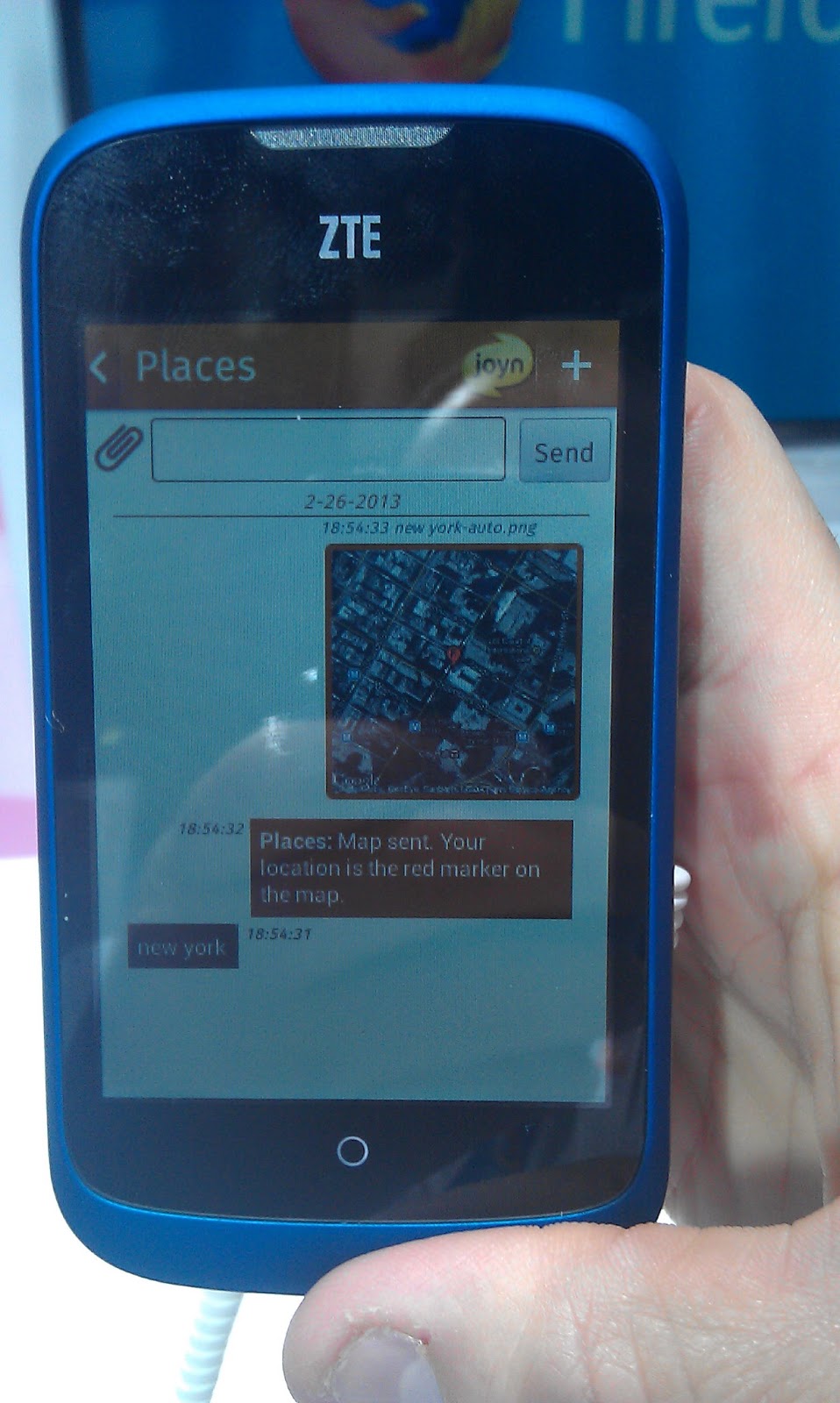
Other hot topic was Firefox OS, the new mobile platform based on HTML5 and new telcos and device manufacturers supporting it. We were the first in the world to demonstrate joyn using HTML5 in Firefox OS devices using the developer devices (1st Firefox OS device) by our friends of Geeksphone.

We could also install our joyn client in the stand of ZTE with ist Firefox OS phone, and took 1 pic :-)

As Firefox OS could be the first smartphone for most of people, telcos can leverage it by deploying joyn based on our network API, not telcos protocols, just HTML5, our product matches the Firefox OS philosophy, the backend could be telco stuff, but the front-end could be based on web technologies.

As a summary, we are positive, joyn is a kyte starting to fly, winds in favour now.

Regarding the new venue perhaps it is too big and not so well communicated by public transport, we miss the old venue for MWC.
Our photo-album of the event just here


Showing posts with label telco API. Show all posts

Thursday, December 20, 2012

Combining Voice & joyn APIs to create new communication experiences.

Just created a simple service using a phone call to record a message that will be sent to a group of people using joyn messaging. It took just 4 hours to code the service, put it live, and test it. With this demo we want to show how easy is combining different telco APIs to create innovative services around standard communication services as a mash-up of them. For voice we used Tropo by Voxeo Labs and for joyn we used our own API, RCS Solution GW Product :-)


Showing posts with label telco API. Show all posts

Wednesday, November 28, 2012

Voxeo Labs and Solaiemes Bring WebRTC Video Calls to Existing Mobile Numbers


San Francisco and Madrid (PRWEB) November 28, 2012
Voxeo Labs and Solaiemes announced today a strategic partnership to deliver web-based video calling to current mobile subscribers using their existing phone number and address book. The combined Voxeo Labs/Solaiemes solution enables mobile and fixed carriers to reach a global audience allowing customers to chat, share pictures and engage in real-time video chat from any device with an Internet connection and modern web browser. 

This announcement comes at the heels of two major developments in the communications industry. The first is RCS/joyn, a global upgrade of telco infrastructure promising to enable rich media and video calling features combined with messaging, similar to Apple’s iMessage and FaceTime, on any carrier network or mobile device.

The second major development is the emerging web technology, WebRTC. WebRTC standardizes access to the camera and microphone in modern web browsers. The technology provides any web developer the ability to easily add high-quality audio and video technology to existing websites and social networks. Voxeo Labs is one of four editors developing the WebRTC specification along with Mozilla, Cisco and Ericsson. 

“It’s a perfect match,” says Voxeo Labs CTO, Jose de Castro. “Solaiemes already has a mature platform for embedding mobile texting, presence and media sharing onto the web so adding real-time voice and video was the next logical step. Our Phono WebRTC Gateway plugged right in to complete the end-to-end solution.” 

With these technologies, carrier marketing teams can think outside the phone to deliver truly unique multi-screen experiences. Now ‘triple play’ carriers offering high speed Internet, television and phone service can leverage their position in the home to further push the boundaries of family conversations and introduce a new wave of social-powered entertainment. 

“Teaming with Voxeo Labs, the leader in WebRTC, Solaiemes RCS Thin Client Server solution offers to carriers a full joyn/RCS experience (messaging, file transfer, rich video call) in any platform with a web browser (mobile, tablet, desktop, TV),” says Solaiemes co-founder, José Recio. “Combining Rich Communication Suite network API and WebRTC make joyn an ubiquitous carrier-backed service, jumping ahead OTT solutions and genuinely useful to customers”.

The new WebRTC powered gateway will be offered and sold by Solaiemes as an upgrade to their existing RCS Thin Client Server in early 2013. 

About Voxeo Labs
Voxeo Labs invests in core platform research, incubates revolutionary ideas and innovates new communications solutions in collaboration with our partners and carrier customers. The company leads the real-time web communications industry with their work on WebRTC, Tropo and related technologies. For a complete list of products, projects and services, visit http://voxeolabs.com.

About Solaiemes 
Solaiemes creates infrastructure to help carriers, MVNO's and service providers to enrich the communication experience making it ubiquitous and available to 3rd parties to create value added services on top. Solaiemes pioneered the 3rd party API exposure of RCS/joyn to build application to person and person to application use cases and different types of endpoints, combining telco and internet spaces. Visit http://www.solaiemes.com 

Press Contact for Voxeo Labs 
Cristina Moe Voxeo Labs +1 415 489 0734 
cristina(at)voxeolabs(dot)com

Showing posts with label telco API. Show all posts

Monday, October 15, 2012

Why exposing RCS-e/joyn telco enabler as UNI API?

We are being asked about why exposing the telco enablers as UNI (user to network interface) API. Telcos need to understand the advantage of exposing their assets from the end-point point of view.
There are several reasons:

Avoid lock-in: if you expose the capabilities based directly on IMS and/or instant messaging server interfaces, some propietary shortcuts (and "optimizations") would be introduced and thus create lock-in. This forces that both core and API has to be provided by the same vendor and will be difficult to replace.

Security: when exposing RCS-e as end-point (virtual client) the user of the API can only do the same actions that a phone will do, no more. And subject to exactly the same security enforcement checks.

If the API application is behaving not properly, just removing the "user identity" of the application from the core using the same procedure as with a phone is enough.

Remember, in this way of exposure, the API and solutions using it are outside the SBC and then formally outside the network. Developers would be trusted as a phone would, with no extra security invesment over having the same number of "normal" users.

OSS/BSS savings: provisioning, billing, rating, etc. is done re-using the same systems in place for "normal" users. No need to create a different kind of users for applications in vendor-proprietary systems with a huge OSS/BSS investment. With UNI exposure an application uses an RCS-e user created in the same way as a "normal" user.

Cloud-based exposure: with UNI-based exposure, telcos can keep core (IMS, IM server) at their premises and adopt cloud based API exposure. Benefits: OPEX savings; shorter times to scale the API according to the usage requirements; possibility of offering the same API to several opcos or even resell to other operators, etc.

Standard compliance and testing: when RCS-e is exposed to 3rd parties as an UNI API, it behaves as client, there are no dependencies on what's inside the network. Once the API based virtual client interoperates with the device clients in the market it is clear that your API exposure will be allowing to create 100% RCS-e/joyn compatible solution on top.

For those reason Solaiemes pioneered the UNI approach to expose RCS :-)
Feedback welcomed.


Showing posts with label telco API. Show all posts

Tuesday, July 31, 2012

Telco API Standards? Our view

We are following up a controversial debate about the need of standards for Telco API. You can find a poll and an interesting debate in the Telecom API group in linkedin.
We saw how both GSMA & OMA worked for creating standard API for network telecommunication enablers. GSMA One API is a clear example.
The problem comes when the standard arrives too late and developers either just looked for other APIs to use the telco enablers or worse for the telcos, directly gave up and try to create their own communication capabilities as the global reach telco enablers were not exposed with affordable API in terms of cost and "usability".
RCS-e/RCS need of exposure API was included from the beginning and it will speed the market adoption, Solaiemes already has REST and SOAP WS API exposure of RCS-e independent of the selected IMS and Instant Messaging vendor (as it is UNI exposure).
OMA recently published the RCS-e API standard specification and Solaiemes will offer also this flavour in August.
Our view is that standard is good but should not sacrifice the time to market. It is more important the language (REST) that having exactly the same methods. Developers customed to work with REST API from internet world (Twitter, Facebook, Google, etc) know and accept that periodically some methods are changed to introduce new paremeter, additional call are added, and it took few hours to adapt their solutions and test them. Then, it is not problem for the developers the telcos need to address not having a fully static and pre-standardized API, the problem is not having the API itself.
Developers need REST API (event more methods or some of them changing along the time) and a web portal to sign and start testing with telco enablers. It's all. Voxeo & Twilio had proven that with legacy telco enablers as voice and SMS.

The conclusion that standards are welcomed but it makes no sense to delay the commercial offer of telco enabler exposure until a standard comes. The cost of opportunity (fragmentation and recoding) of not having an standard for APIs is less that not having an API.
Solaiemes has now a full commercial implementation of the RCS-e/Joyn API working today and being implemented in telcos, and will offer the standard API implementation in the same platform, with a one click smooth transition when required.


Showing posts with label telco API. Show all posts

Monday, May 14, 2012

Our views on CTIA Wireless 2012.

Last week we were in New Orleans exhibiting at CTIA and it was great. Perhaps it is true that CTIA is loosing some big exhibitors once NA & LATAM are opting for UMTS as 3G and LTE as 4G and then the MWC is becoming the main marketing event for big players.
Instead, CTIA had a lot of vibrant companies showcasing pure innovations, small companies delivering high end innovation to help carriers and delight users.
We focus our presence in evangelizing and explain why messaging (RCS, RCS-e, Joyn) must become a platform, not only a person to person messaging alternative to the existing ones.
We had very positive feedback about our Friendly Telco Border concept and how we apply it to RCS case by delivering REST API (easy to use for whatever non-telco aware developer) to create both: services and web/thin clients.
Several telcos agreed that they way to compete is exposing the telco enablers in the way it could be used by third parties and Parlay and face to face interoperations with core infrastructure are not the way. Several MNOs are waiting for first RCS-e live deployments and the availability or out of the box enabled device to start the proccess of launching: RFI, trial, etc but expecting that time to market will be less than 6 months as they will be deploying already interoperated technology and native clients. Crossing fingers then.
Finally we talk with other core vendors to partner in areas where we are clearly not overlapped but complementing and creating a powerful end-to-end.
Hope to tell you news about this point in the next weeks.