Monday, September 30, 2013

Solaiemes participated in the TelcoAPI workshop at SDP Summit.

Solaiemes had the opportunity to attend the SDP Global Summit organized by Informa Telecoms  & Media the past 17-20th September in Rome.

It was an interesting event with telcos and vendors explaining their approaches to the "service delivery". Topics as how close API exposure & telco core have to be in the architecture and long tail versos internal/enterprise users to be the target were discussed.

Our opinion is that telco exposure may be done in a way that could be deployed easily, and with no/little integration tasks. We know big vendors sometimes like the complexity as a form of lock-in but we embrace UNI-exposure (user to network interface, API behaving as telco-client/end-point). It is the way we are doing for RCS API exposure and also for WebRTC-Telco exposure.

We are including our slides from the TelcoAPI post-conference Workshop chaired by Alan Quayle where we could share the stage with great companies as Tropo, Telestax & Apidaze. We talked about RCS API as opportunity for telcos in the B2C communications space.


Alan Quayle just published about the SDP Summit review and the TelcoAPI Workshop with his own slides and the slides from participants in the SDP Summit and the workshop.

We particularly recommend the slides 36-64 of the his presentation, priceless as it is described with funny slides why the old-telco mindset could make telcos irrelevant soon. It would make no sense, many vendors, established ones and young blood ones are trying to help them to stay relevant and competitive players in the new communication services field.


Wednesday, September 4, 2013

Voxeo Pioneers Use Of joyn In Business-To-Consumer Communications Using Solaiemes’ RCS API Gateway

Voxeo CXP is the first Multi-Channel Application Platform to support joyn as a communication channel for more engaging mobile customer self-service 

Cologne, Germany and Madrid, Spain, September 04, 2013 – Voxeo, an Aspect company, is pioneering the use of the joyn messaging service in business-to-consumer communication by adding it to its award-winning Voxeo CXP multi-channel self-service platform, allowing companies to offer much richer, more engaging mobile self-service communications to their customers. Voxeo has integrated joyn into its CXP (formerly VoiceObjects) platform using the Solaiemes’ RCS API Gateway, creating a developer-friendly environment for fast and easy deployment of joyn-powered apps to existing customer communication strategies.

joyn was developed by the GSMA as a joint service initiative between carriers and handset providers. It allows individuals and organisations to share images, documents, music, video and other files during or outside of a regular telephone call. Like SMS, it comes pre-installed and configured on the mobile phones of participating carriers. Voxeo’s award-winning CXP application lifecycle management suite is the first multi-channel self-service platform in the industry to support joyn, helping to advance the Rich Communications Services (RCS) network.

 “joyn has huge potential for business-to-consumer communication, both in agent-assisted and automated self-service solutions,” says Tobias Goebel, Voxeo’s director of mobile strategy. “By introducing joyn to Voxeo CXP via Solaiemes’ RCS API Gateway, it becomes exceptionally easy for organisations to add joyn-powered apps to their customer communication strategies in a fully integrated fashion.”

Voxeo CXP is the first application development and lifecycle management suite that helps customer service departments build, deploy, manage, and analyse automated applications on joyn, in addition to the IVR, mobile Web, and SMS channels that CXP also supports. Voxeo has integrated joyn with its CXP platform using the Solaiemes’ RCS API Gateway. Solaiemes facilitates the integration of non-RCS platforms through a simple but powerful HTTP interface.

Voxeo deployed a pilot program of joyn-enabled Voxeo CXP with one of its European mobile carrier clients. The carrier reported a high degree of success in designing self-service applications that, for example, allow the customer to request account status information or top up their prepaid account.

Voxeo and Solaiemes expect the joyn-enabled CXP platform to be adopted rapidly by its mobile carrier clients, who are eager to derive added value from their investment in the development of this new messaging standard. Ultimately joyn should see adoption in the enterprise as well, as its communications streams can be encrypted, thereby allowing more secure B2C communication than can be provided by third-party vendors. For example, travel companies could use it to allow self-service and ticket distribution, or insurance companies to capture video footage of accident damage.

 “Solaiemes envisioned from the beginning the potential of joyn instant messaging as something beyond the person-to-person casual messaging, and considered it a perfect channel for B2C communication,” comments Juan Mateu, Solaiemes co-founder. “It is exciting to see Voxeo add joyn as a communications channel in its CXP multi-channel self-service platform and make joyn available to companies to communicate with their customers”.

About Solaiemes
Solaiemes creates infrastructure to help carriers, MVNO’s and service providers to enrich the communication experience making it ubiquitous and available to 3rd parties to create value added services on top. Solaiemes pioneered the 3rd party API exposure of RCS/joyn to build application to person and person to application use cases and different types of endpoints, combining telecommunications and internet spaces. Visit http://www.solaiemes.com

About Aspect
Aspect’s fully-integrated solution unifies the three most important facets of modern contact center management: customer interaction management, workforce optimization, and back-office. We help the world’s most demanding contact centers seamlessly align their people, processes and touch points to deliver remarkable customer experiences. For more information, visit www.aspect.com.

About Voxeo
Voxeo, an Aspect company, removes the locks that make voice, SMS, instant messaging, Twitter, web chat, mobile web, unified communications and self-service applications difficult to create, manage, analyze, optimize and afford. Every day we work to unlock the neglected value of these communications solutions with open standards, disruptive innovation and a passion for problem solving–fueled by an obsession with customer success. We do so for more than 250,000 developers, 45,000 companies and half of the Fortune 100. Visit us or join our conversations on the web at www.voxeo.com, blogs.voxeo.com, or twitter.com/voxeo.

PR at Voxeo's site

Wednesday, August 7, 2013

WebRTC Phone. Fix phone is not anymore something tied to a wire.

Following our previous post where we show a full communicator based on WebRTC including voice, video, and RCS/joyn features we received some questions from customers & prospects about if it could be used only to extent the reach of traditional PSTN or VoIP numbers with a simple UX.

The answer is YES, OF COURSE. We prepared a simpler WebRTC Phone supporting voice call, phonebook (NAB, network address book) and the call register. Have a look please:


(*) Note: it is difficult to record the live audio from demos :-(, but we can say and show the audio-quality is better that it could seem listening the video :-)  You can request a demo.


Tuesday, July 23, 2013

Google Chrome becomes a real phone with Solaiemes WebRTC.

Solaiemes is using WebRTC to build a compelling solution to help telcos to deliver ubiquitously their communication services. Now, we have created for Google Chrome (the most advanced WebRTC browser) a web-phone that enables a PSTN line (it could be also a mobile line or VoIP) to be accessed everywhere just with a browser.
You can see how you can dial a number and make a simple call, or you can be reached by a mobile joyn capable number and enjoy the features of RCS/joyn as video-share.


Fix carriers are no restricted anymore to offer communications tied to a physical wire, VoIP telcos are now free to offer their services tied to softphones to be installed or VoIP physical phones, mobile numbers will be also available from a web browser. The communications revolution is just starting and telcos must defend its role by delighting their customers.


Tuesday, July 2, 2013

Solaiemes to offer joyn as a platform for Firefox OS. Personal messaging & chat based use cases in one.

Finally Firefox OS is taking off. The web as a platform in this new concept of smartphones matches completely with the Solaiemes vision of keeping telco stuff at telco side, and build the communication experience witht the telco API exposure.

Solaiemes already has a HTML5 client for Firefox OS to be tested by telcos in the market. It is based on the standard OMA RCS API exposed by RCS Thin Client Server product, compatible with all RCS core solutions (ZTE, Newpace, Ericsson, etc) and even with SIP Servers as Kamailio.

See what can be done with joyn on Firefox OS in this minisite joynfirefoxos.solaiemes.com

We are offering to test it in our RCS-Lab environment and test also the concept of chateable services (info services, casual games, self-service CRM) that you can also create easily with the REST API.

Also, it could be used as client for the GSMA joyn Innovation Accelerator  to test the use cases you are creating.

It's time for telcos comitted with Firefox OS to take an active role in enriching the platform with useful services and also create a framework for open innovation with 3rd parties using joyn API.
Developers can now work in a way to create alternative UX to use their services using enriched messaging: chat, group chat, file transfer, location push, etc. In this new platform joyn and OTT messaging are departing from the same line, and telcos can take the lead if move faster, just try :)

We are offering trial package for telcos including:

- 6 months license for RCS Thin Client Server (powering joyn client comms) & RCS Solution GW powering the 3rd Party exposure API to create A2P & M2P cases.
- Integrating with telco RCS full core (IMS + IM AS), IMS or using a SIP server as core. We can provide with a partner a hosted RCS Core if needed.
- Developer portal with testbed pc client to test easily the use cases based on joyn created.
- Training to internal developers and telco developer partners & Hackaton participation.
- A package of hours to help the telco to create own proof of concepts of joyn based service.
- Upon request support.


Wednesday, June 19, 2013

joyn casual games, m-learning & sponsoring of interactive services as a new way of mobile marketing.

We are presenting a new demo to demonstrate the use cases of joyn as a platform for services. A casual game based on chat interaction which also can be a learning tool has been creating by combining our RCS network API and a content API, a linguistic API by our friends of Molino de Ideas, see APIcultur.

Also, we unveil how these services can be offered for free to the users and monetized with smart advertisement & couponing, with perfect targetting as you can find the right sponsor to the use case offered. In-joyn-advergaming is born :-)


Quick service development, easy mash-up combining APIs, smart advertisement space, fun for the user...let's think in joyn because the person to person messaging initial case.

Monday, June 3, 2013

Telcos & You Developer. Our presentation at API Days Mediterranea

We were invited to speak at API Days Mediterranea event organized by apicultur (thanks a lot for the invitation).

It was a very interesting event about APIs: types of API and use cases, API management approaches, API business models and also telco APIs.

We would like to share the slides and demos of our talk about the telcos and their new role close to developers by exposing their communication APIs and RCS / joyn as a potential huge enabler for devs.


Looking forward next time event :-)

Friday, May 17, 2013

joyn location push API. The future enabler for LBS. Demo: city bus information.

We want to unveil a new call of our joyn API, the location push and want to explain how it can be a key enabler for future LBS in the fields of information, couponing, advertisement.
In this demo we are using joyn to create a real time information system of public transportation. We are using OpenData API from EMT, the local city bus company in Madrid.


The future of mobility will be creating a lot of services combining content APIs and channel API as the joyn/RCS. No need to install individual apps to access to each type of info you may require, just the phonebook will be the hub of services. Stay tunned, soon more.

Tuesday, April 30, 2013

IMS World Forum summary.

We attended the IMS World Forum last week and also showcased in the WebRTC pre-conference Workshop our case of WebRTC, to create ubiquitious Unified Communications in the browser combining voice and joyn and using WebRTC for media.

Alan Quayle who chaired the workshop just published a post with all the slides and demos showcased there. Once againg we could see that small companies are ahead both in vision and execution of telcos and could be very helpful if telcos approached properly.

Some points to summarize the conference:

a) Finally IMS is taking off but too linked to particular services as VoLTE, telcos are not seeing yet IMS as core container of multiple services and just wants the first case to pay the full IMS. This is not easy.

b) In case of RCS, RCS in a box and/or hosted vendors (as Newpace) are finding a very good opportunity there. RCS is getting traction as more vendors not involved till now are offering now Instant Messaging Application Server.

c) We could identify among the speakers the ones finding reasons to do and the others looking for reasons to delay and delay and delay. Some speakers talk about WebRTC as opportunity to create endpoints for IMS but they talked about the need to wait until codec issue was solved and be sure about QoS control. As the chair of the session pointed, last chain of QoS can not be controlled, it is not a real advantage.
Also, we knew about IMS based services deployment plans, for example the presented by Sebastian Schumann by Slovak Telekom Mavenir speaker slides included MetroPCS roadmap including joyn API enabled cases, sharing our vision.

d) A lot of debate about business models. Telcos did not understand yet that Say's Law is real today in the IT space. Supply created demand. It happened with OTTs, it happened with independent telco APIs  as Tropo or Twilio. Telcos may take a bit of risk to create services that can attract the demand and see how to monetize. We talk recently about that in this post.


Monday, April 8, 2013

Solaiemes to demonstrate enabling PSTN+joyn ubiquity using WebRTC in IMS World Forum.

We will be demoing at IMS World Forum 2013 (organized by Informa TM) how telcos can take the benefits of to new technologies RCS messaging and WebRTC to access to media components of devices to revamp the value of PSTN (and also mobile) lines. We would like to show how Unified Communications could be built just a mash-up of standards and APIs.

The pre-conference WebRTC Wosrshop will be conducted on Monday 22nd and will be conducted by Alan Quayle (telco analyst & owner of Alan Quayle Business & Service Development) and Jose de Castro (Voxeo Labs CTO).  You can see the list of companies and demos participating in these posts in the Alan's blog http://alanquayle.com/2013/02/webrtc-at-the-ims-world-forum/ and a further update http://alanquayle.com/2013/04/update-apidaze-io-quobis-and-telestax-join-the-webrtc-pre-conference-at-the-ims-world-forum/

We would like to say thanks for the opportunity to demo how to apply our technology to the telco world and share event with companies we know as Voxeo Labs, Telestax, Quobis, etc and meet there other amazing companies.

We will be also attending the full event and available for networking. If you also attending and want to know more about that and what we are doing for joyn/RCS and WebRTC email us to schedule a meeting.

Wednesday, March 27, 2013

Telcos: from cash cow farm to worker bee hive.

Telcos are in a challenging position, they have to change to adapt to the new times and new competition and it is not easy. Traditionally services providers business models were based in a few cash cows under their control or farm, and customers customed to consume milk forever. The life expectancy of a cow is about 20 years. It was quite easy till now, telcos invested in networks and they have milk for years and years to sell to their customers.

Companies using the data connectivity, so called OTTs, had cannibalized the revenues from sacred cash cows and it was a fast process when combined 3G and smartphones rise.


Net neutrality is here, it is here to stay, and it is fair that net neutrality exists. The service providers may not leave the tradidional role of providing "communication services" to become "just pipe" but they may adapt to new times and new ways of creating and offering "communication services" to their customers. It is time to compare cows and worker bees.

- Cows live 20 years and bees live about 100 days.
- Cows tend to live in a closed farm and be a reduced number (tens, hundreds in each farm), worker bees are living thousands in each hive.
- The milk from a cow is measured in litres, the honey produced by each hive just grams.

Business analogies are clear:

- Money will come from honey sweets.
- Each revenue from a worker bee will last a reduced time but new services-sweets will be replacing old ones in a very fast cycle, the same observed in OTT space.
- Big amount of bees can not be in a telco closed environment and fully under control, bees will be also 3rd parties.
- The hive will be the API and the API will keep the produced honey.

What is the new role of the telco, becoming the perfect hive, exposing their enablers (Voice, IMS, RCS/joyn) to be a good home for developer bees and also creating a model were bees also could feed themselves from their honey production.

Telcos may become hive / platforms. The sooner the better.


Friday, March 8, 2013

MWC 2013 Summary: finally joyn is taking off.

One week after MWC we would like to summarize the key topics related with the technology we do.
Finally joyn took off, announcements as America Movil launching in Mexico using the Vodafone hosted core and the brave move from MetroPCS announcing the lauch of joyn as OTT for non-customers in North America were impressive. We were visited by other telcos soon to launch using that shared joyn hosted core asking about our network API exposure and compatibility (yes, it is compatible).

Also the RCS Seminar was very interesting and we could listen from marketers from big consumer brands as CocaCola and L'Oreal talk about the need of a "multimedia" global reach way to interact with customers, and joyn could be this new global reach channel. This is what our API enables :-)

We received many visits, and visitors sent to our booth by previous visitors. We received people from 5 continents, and even were interviewed for an asian TV broadcaster and received a positive mention by a telco leading analyst, Alan Quayle. We also met potential investors and new potential partners.

After 1 week read new annoucements as Zain lauching joyn in the Middle East and Forrester starting to cover joyn and pointing its role for business comms and the API as key element and we know that more telcos are issuing RFI/RFP for RCS core solutions and requiring network API exposure, good to see they got the "as a platform" concept.

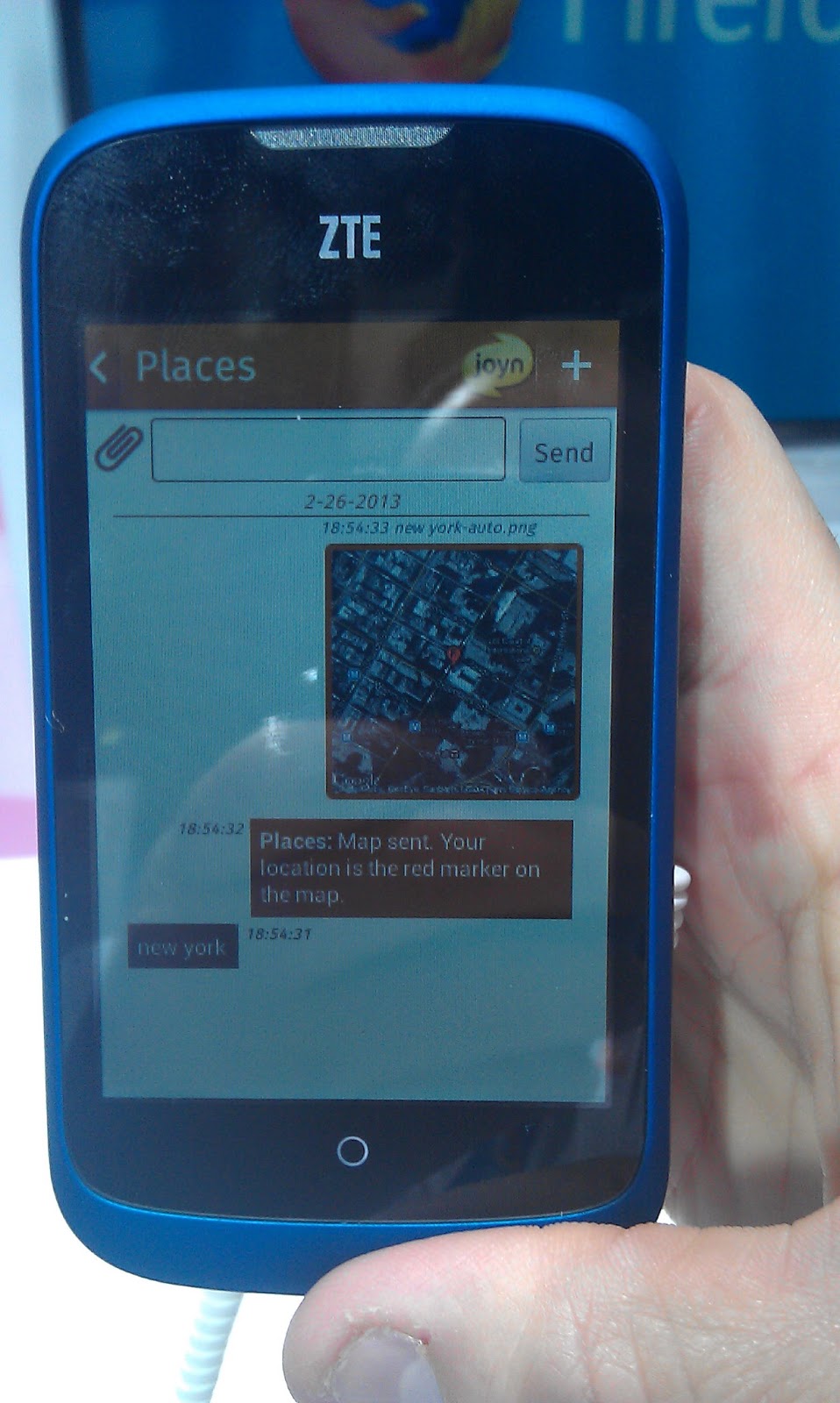
Other hot topic was Firefox OS, the new mobile platform based on HTML5 and new telcos and device manufacturers supporting it. We were the first in the world to demonstrate joyn using HTML5 in Firefox OS devices using the developer devices (1st Firefox OS device) by our friends of Geeksphone.

We could also install our joyn client in the stand of ZTE with ist Firefox OS phone, and took 1 pic :-)

As Firefox OS could be the first smartphone for most of people, telcos can leverage it by deploying joyn based on our network API, not telcos protocols, just HTML5, our product matches the Firefox OS philosophy, the backend could be telco stuff, but the front-end could be based on web technologies.

As a summary, we are positive, joyn is a kyte starting to fly, winds in favour now.

Regarding the new venue perhaps it is too big and not so well communicated by public transport, we miss the old venue for MWC.
Our photo-album of the event just here


Tuesday, February 26, 2013

Synchronoss to use Solaiemes RCS Thin Client Server API to deliver web based RCS with its NAB & Personal Cloud

Synchronoss (Nasdaq SNCR) today released a PR during MWC 2013 that will showcase RCS communication as part of its Personal Cloud and Network Address Book products.
The demo will show the integration of RCS (joyn) web client using Solaiemes RCS Thin Client Server API.

The Synchronoss PR
http://www.reuters.com/article/2013/02/26/nj-synchronoss-idUSnBw7pC6Sva+114+BSW20130226

We are glad to see companies adding RCS capabilities to their products and check the amazing potential of RCS joyn REST API to add new use cases and applications to joyn.


Thursday, February 21, 2013

joyn for Firefox OS, telco IMS messaging delivered as web

Happy to announce our solution to power joyn in Firefox OS devices. See our videodemo: joyn communication between Firefox OS client and Android GSMA accredited client.


We believe in the Firefox OS philosophy of using web standards and our solution uses the joyn API to avoid to put SIP, MSRP protocols in the device. The joyn API Server (RCS Thin Client Server product) + HTML5 frond-end is the right combination to deliver mass market rich communications in many markets where Firefox OS is forecasted to get meaningful marketshare. 


Credits: 
Firefox OS device: Geeksphone Keon
joyn Android app client: Silta Neusoft 
joyn API & HTML5 client: Solaiemes