Wednesday, November 28, 2012

Voxeo Labs and Solaiemes Bring WebRTC Video Calls to Existing Mobile Numbers


San Francisco and Madrid (PRWEB) November 28, 2012
Voxeo Labs and Solaiemes announced today a strategic partnership to deliver web-based video calling to current mobile subscribers using their existing phone number and address book. The combined Voxeo Labs/Solaiemes solution enables mobile and fixed carriers to reach a global audience allowing customers to chat, share pictures and engage in real-time video chat from any device with an Internet connection and modern web browser. 

This announcement comes at the heels of two major developments in the communications industry. The first is RCS/joyn, a global upgrade of telco infrastructure promising to enable rich media and video calling features combined with messaging, similar to Apple’s iMessage and FaceTime, on any carrier network or mobile device.

The second major development is the emerging web technology, WebRTC. WebRTC standardizes access to the camera and microphone in modern web browsers. The technology provides any web developer the ability to easily add high-quality audio and video technology to existing websites and social networks. Voxeo Labs is one of four editors developing the WebRTC specification along with Mozilla, Cisco and Ericsson. 

“It’s a perfect match,” says Voxeo Labs CTO, Jose de Castro. “Solaiemes already has a mature platform for embedding mobile texting, presence and media sharing onto the web so adding real-time voice and video was the next logical step. Our Phono WebRTC Gateway plugged right in to complete the end-to-end solution.” 

With these technologies, carrier marketing teams can think outside the phone to deliver truly unique multi-screen experiences. Now ‘triple play’ carriers offering high speed Internet, television and phone service can leverage their position in the home to further push the boundaries of family conversations and introduce a new wave of social-powered entertainment. 

“Teaming with Voxeo Labs, the leader in WebRTC, Solaiemes RCS Thin Client Server solution offers to carriers a full joyn/RCS experience (messaging, file transfer, rich video call) in any platform with a web browser (mobile, tablet, desktop, TV),” says Solaiemes co-founder, José Recio. “Combining Rich Communication Suite network API and WebRTC make joyn an ubiquitous carrier-backed service, jumping ahead OTT solutions and genuinely useful to customers”.

The new WebRTC powered gateway will be offered and sold by Solaiemes as an upgrade to their existing RCS Thin Client Server in early 2013. 

About Voxeo Labs
Voxeo Labs invests in core platform research, incubates revolutionary ideas and innovates new communications solutions in collaboration with our partners and carrier customers. The company leads the real-time web communications industry with their work on WebRTC, Tropo and related technologies. For a complete list of products, projects and services, visit http://voxeolabs.com.

About Solaiemes 
Solaiemes creates infrastructure to help carriers, MVNO's and service providers to enrich the communication experience making it ubiquitous and available to 3rd parties to create value added services on top. Solaiemes pioneered the 3rd party API exposure of RCS/joyn to build application to person and person to application use cases and different types of endpoints, combining telco and internet spaces. Visit http://www.solaiemes.com 

Press Contact for Voxeo Labs 
Cristina Moe Voxeo Labs +1 415 489 0734 
cristina(at)voxeolabs(dot)com

Friday, November 9, 2012

Our slides for the joyn Innovation Challenge workshop.

We had the chance as technology partner for RCS API of the joyn Innovation Accelerator to expose our views about joyn monetization via API with our business vision for messaging and examples of what can be done on top of messaging with the API (A2P-P2A use cases and alternative endpoints or clients) in the Workshop the past November, 8th in Berlin.

Find below our slides: 


Also you can find all the slides of all of presenters including Newpace as Hosted RCS-e technology partner of JIA, GSMA staff working with the API and the RCS Marketing Team and the Deutsche Telekom representative that explained their plans regarding joyn API, you can download the full pack of slides here.

The developers attending make interesting questions after the presentations and the later networking, we receive some feedback in the same way we are receiving from developers we know well, banks, big retailers, utilities like the Apps but they are asking for some common reach mechanism to interact with their customers, a new SMS full multimedia. It makes clear the joyn potential for value added services.


Thursday, November 8, 2012

Solaiemes selected to provide GSMA joyn Innovation Accelerator 3rd party API exposure.

We are happy to announce that Solaiemes RCS API technology has been selected to power the GSMA joyn Innovation Accelerator API exposure.

 The Innovation Accelerator gives developers global access to a live GSMA Rich Communication Services (RCS) network where they can build on RCS APIs and test their new service or application ideas in a trusted and safe environment.

The Solaiemes products involved to expose joyn (RCS) as OMA REST API are RCS Solution Gateway and RCS LiveServe. Solaiemes API technology was deployed in a cloud enviroment and "plug&play" interoperated with the RCS Core vendor selected, Newpace, with the product rcsCloudConnect and exposed through the GSMA developer portal powered by Aepona and TNS.

"The 'RCS as a platform' vision that Solaiemes put forward is happening, this platform will allow developers and operators to experiment with their ideas, lowering entry barrier. Expect additional announcements soon, Solaiemes is working with several multinational carriers in the area of joyn 3rd party API exposure and OTT-like telco services built on top of the joyn API" says Jose Recio, Solaiemes co-founder.

We’d like to encourage individuals and start-ups to register in the joyn Innovation Accelerator in our network to get involved in developing new applications and use cases for a technology that will change the way people communicate.

The GSMA joyn Innovation Challenge is a good opportunity to earn the possibility of showcasing your ideas to use joyn in the coming Mobile World Congress 2013. We would like to thank the GSMA initiative to engage developers as a part of joyn future.


Wednesday, October 31, 2012

Solaiemes will attend Rich Communications 2012 and GSMA events in Berlin next week

Solaiemes will attend next week 2 events in Berlin. On 6-7 November the Rich Communication 2012 event by Informa Telecom and Media and the joyn Innovation Challenge workshop by the GSMA.

In the Rich Communication 2012 event Juan Mateu, our co-founder will participate as panelist in the panel "Analysing the future for RCS as a mass market service – how to maximise return on investment" and will explain our view about making RCS-e / joyn the first messaging alternative conceived "as a platform" to deliver use cases on top  by 3rd parties thanks to the API.


Also we will attend the workshop about the joyn Innovation Accelerator. We posted about it.

Developers, no matter where they are based, now can have access to a live joyn system and familiarize with the API to explore the possibilities of using the messaging as a platform and creating their own proof of concept of services.
Solaiemes is a technology partner of the joyn Innovation Accelerator.

For us it is very relevant that joyn will have network API (telco API) from the beginning, it could help to boost innovation around the RCS in the same way that it was done with SMS in the past with the SMS gateways and today is being done with compelling APIs.

We promise to blog back about the highlights of both events :-)

If you are going to attend whatever of these events and want to meet us, drop us a email or tweet and we will contact you.


Thursday, October 25, 2012

joyn TV experience. Adding value to the home phone line.

We are happy to show the joyn TV experience. With our RCS-e API from RCS-e Thin Client Server we created an Smart TV App joyn client (using the Samsung Smart TV Hub for Samsung TVs). In the video you can see how even fix carriers can use the home phone number to add media and IP messaging trough the "big screen".
Why not calling your mum after reaching a high summit after hours of hiking and just share your landscape from there on her big TV?

Credits: Solaiemes RCS Thin Client Server API, Silta Neusoft Mobile joyn Client and Samsung Smart TV Hub 


Wednesday, October 24, 2012

joyn Innovation Challenge, the GSMA competition for mobile & web apps developers.

The GSMA has announced the joyn Innovation Challenge, an initiative to encourage innovation based on joyn.
Developers will have the opportunity to use a real joyn enviroment and using the API build innovative use cases on top of the messaging experience. The best new ideas will be showcased on the GSMA’s exhibition stand at the Mobile World Congress.

Developers will have access to the joyn "Innovation Accelerator" a global access to a live GSMA Rich Communication Services (RCS) network where they create their own use cases on RCS APIs, Solaiemes is technology partner, see the banner :-), and test their use cases in a trusted and safe environment. GSMA explains in the website that the use of the Innovation Accelerator will be free and you do not have to enter the competition in order to use it. We consider this initative a very good move.

We want to highlight that API becomes key in joyn from the beginning and it means that joyn aims to be seen as a platform, our vision being evangelized the last years. It is great that the industry realizes that it is not about replicating telco version of great OTT messaging products that going beyond and creating an open platform based in a natural experience as the messaging.


Monday, October 15, 2012

Why exposing RCS-e/joyn telco enabler as UNI API?

We are being asked about why exposing the telco enablers as UNI (user to network interface) API. Telcos need to understand the advantage of exposing their assets from the end-point point of view.
There are several reasons:

Avoid lock-in: if you expose the capabilities based directly on IMS and/or instant messaging server interfaces, some propietary shortcuts (and "optimizations") would be introduced and thus create lock-in. This forces that both core and API has to be provided by the same vendor and will be difficult to replace.

Security: when exposing RCS-e as end-point (virtual client) the user of the API can only do the same actions that a phone will do, no more. And subject to exactly the same security enforcement checks.

If the API application is behaving not properly, just removing the "user identity" of the application from the core using the same procedure as with a phone is enough.

Remember, in this way of exposure, the API and solutions using it are outside the SBC and then formally outside the network. Developers would be trusted as a phone would, with no extra security invesment over having the same number of "normal" users.

OSS/BSS savings: provisioning, billing, rating, etc. is done re-using the same systems in place for "normal" users. No need to create a different kind of users for applications in vendor-proprietary systems with a huge OSS/BSS investment. With UNI exposure an application uses an RCS-e user created in the same way as a "normal" user.

Cloud-based exposure: with UNI-based exposure, telcos can keep core (IMS, IM server) at their premises and adopt cloud based API exposure. Benefits: OPEX savings; shorter times to scale the API according to the usage requirements; possibility of offering the same API to several opcos or even resell to other operators, etc.

Standard compliance and testing: when RCS-e is exposed to 3rd parties as an UNI API, it behaves as client, there are no dependencies on what's inside the network. Once the API based virtual client interoperates with the device clients in the market it is clear that your API exposure will be allowing to create 100% RCS-e/joyn compatible solution on top.

For those reason Solaiemes pioneered the UNI approach to expose RCS :-)
Feedback welcomed.


Thursday, September 13, 2012

RCS/joyn? It's the network API, stupid

The tittle? Just a little provocation :-) inspired in the in James Carville sentence used during the  Clinton's 2012 presidential campaign: "it's the economy, stupid". The sentence was used to emphasize where the focus were.
Currently telcos are facing the challenge of the fast commoditization of the old cash-cows: voice and SMS and a myriad of OTT communication alternative using the open internet.
Analysts debate about the convenience of creating new standardized and interoperable  communication enablers as RCS/RCS-e/joyn or just creating telco own OTT alternatives.
We may assume that whatever options RCS or telco owned OTT (also known as #TelcoOTT but RCS also can be offered as #TelcoOTT) will not be easy to monetize as person to person communication. Great messaging and VoIP free alternatives or very cheap as Whatsapp, Viber, etc will force the telcos to look for innovative ways to make new revenues to compensate voice and sms revenue decline.
On the other hand we see new telcos as Voxeo and Twilio are making money from those legacy enablers, voice and SMS but not for the person to person communication but using those global reach communication to power enterprise and long tail solutions and applications. It is done by exposing these communication enablers in the language the developers know: API (REST, SOAP).
No need to know about telco protocols, whoever can try to develope solution using comms. Wow.
With this perspective in mind, it is obvious that RCS/joyn in the future with a simple user experience just around the phonebook (as SMS in the past) and affordable price or just bundled with the data plan could target the "global reach". How to monetize this global reach? Yes, the API, the network API. If enterprises and developers can use this enabler for application to person, person to application and machine-to-machine use cases (A2P, P2A, M2M), the value will be there, and the added value will be shared between the parties.
When exposing telco APIs, telcos are giving a white canvas and an affordable set of colour pencils to the 3rd parties. Most of them will paint interesting things with value for them or their own customers, and a few ones will produce artwork masterpieces, both together will generate a lot of value that will be shared.
Remember, all this begins with the white canvas and a few colour pencils.
If the white "voice and SMS" canvas generated a lot of value created by 3rd parties with the API, we may expect the same or more with a new enablers with chat, file transfer, video, voice, and it is RCS.
Then it will be easier to monetize standardized new enablers than individual communication silos.

The API is key for RCS and we are proudly working on that to allow all the telcos to launch RCS service not only as personal communications but as a platform. Let's go!


Tuesday, August 21, 2012

RCS-e/joyn is not just only for mobile carriers.

From time to time we are being asked about if RCS-e/joyn is a technology only for mobile telcos. Our answer is a big NO.
Although RCS-e/joyn is a technology pushed and promoted by the GSMA whose full members are mobile carriers, we see RCS as an new standard IP messaging that could be used ubiquitously with the advantages of the interoperation and federation.
Solaiemes strongly believes in the potential of RCS for triple play telcos, as they can offer a common and global reach messaging experience (hope in the next future joyn we adopted by most of the carriers) in all devices/screens under different types of connectivity.
We believe in the power of the REST RCS Network API to offer RCS-e web and connected TV [soon new video-demo, be patient :-) ] clients.
DSL, Fix & Cable operators can provide then "a new communication service", a personal communication service in the same way they offered in the past a complementary or low fee email account. In the case of the TV, it offers huge possibilities of having the biggest screen of your home to receive pics from family and friends and see them directly there. Also to see incoming videosharing from mobile. Why not have your family on the couch watching TV and being prompted by you streaming live video while hiking when the summit gets closer?
Communications are about sharing experiences, and innovation can be delivered by all actors in the communication space.
It is very easy to integrate the RCS capabilities in softphones provided by fix carriers, or set-top-boxes by cable operators. Also, it you can deliver RCS as web or TV Widget easily. No reason for non mobile telcos to think that they have little choice to bring additional fun and business use cases for their customers.
From CAPEX perspective, if fix or cable telcos are investing in IMS and SBC to provide VoIP or IP media, the same infrastructure can be used to deliver RCS, increasing ROI from already decided and needed investments with the extra cases.
Users will costume to keep several RCS accounts (identities) in the same way that they are right now owning several email accounts or OTT messaging IDs. Value added services as "aggregating" those accounts and let the users set their own messaging policy/rules (IM-Box, auto-responses, filters, messaging divert, videoshare divert etc), we have the IMS AS to allow that, the RCS-e Personal Manager.

- Why not being the fix, cable or broadband carriers being the first ones to deliver those experiences o personal freedom to their users?
- Why not triple play telcos start thinking in "communication as a whole" and not a mere addition different revenue source branches?
- Why not starting to offer fix/TV RCS portable to mobile if the non MNO is also a MVNO?

Solaiemes is a rebel company :-) We like to destroy topics: pioneer technology can be created in a country with no telco equipment companies tradition, small tech start-ups can compete head-to-head with big ones of the telco infrastructure industry (our common challenge these days) and we want to help also non-mobile telcos destroying the industry feeling that fix or cable telcos are not the coolest.

Let's give a try!


Tuesday, August 14, 2012

Solaiemes to offer 1st commercial implementation of OMA compliant RCS network API

We are glad to announce that our products RCS-e Solution Gateway, RCS-e Thin Client Server and RCS-e LiveServe exposing RCS-e capabilities as REST API are now offering the OMA compliant Rest version.
Our views on the need of standardized telco APIs were explained in the former post and in this interesting debate in the Telecom APIs group in Linkedin.
We believe that the key factor of API success is the early availability and to be offered in the "developer language", in the way they like to work, and today it is REST and SOAP WS. Our platforms were offering two flavours, REST and SOAP WS (as some customers consider it better for back-end integrations as CRM systems).
Now, Solaiemes is adding the support of the Open Mobile Alliance RCS Network API flavour which is also REST based.
The same platforms will be exposing simoutaneusly the 3 API flavours and developers will have the freedom to choose the one which fits better with their needs.
Both, our initial REST implementation and the OMA one are REST but we decided to keep also our own version as it is covering some topics that the OMA spec is missing.

We look forward that this move will help telcos to launch RCS-e/Joyn as a platform. It means API for ubiquity, person to application and application to person cases to be offered at the same time that the RCS-e person to person enhanced messaging launch dates :-)


Tuesday, July 31, 2012

Telco API Standards? Our view

We are following up a controversial debate about the need of standards for Telco API. You can find a poll and an interesting debate in the Telecom API group in linkedin.
We saw how both GSMA & OMA worked for creating standard API for network telecommunication enablers. GSMA One API is a clear example.
The problem comes when the standard arrives too late and developers either just looked for other APIs to use the telco enablers or worse for the telcos, directly gave up and try to create their own communication capabilities as the global reach telco enablers were not exposed with affordable API in terms of cost and "usability".
RCS-e/RCS need of exposure API was included from the beginning and it will speed the market adoption, Solaiemes already has REST and SOAP WS API exposure of RCS-e independent of the selected IMS and Instant Messaging vendor (as it is UNI exposure).
OMA recently published the RCS-e API standard specification and Solaiemes will offer also this flavour in August.
Our view is that standard is good but should not sacrifice the time to market. It is more important the language (REST) that having exactly the same methods. Developers customed to work with REST API from internet world (Twitter, Facebook, Google, etc) know and accept that periodically some methods are changed to introduce new paremeter, additional call are added, and it took few hours to adapt their solutions and test them. Then, it is not problem for the developers the telcos need to address not having a fully static and pre-standardized API, the problem is not having the API itself.
Developers need REST API (event more methods or some of them changing along the time) and a web portal to sign and start testing with telco enablers. It's all. Voxeo & Twilio had proven that with legacy telco enablers as voice and SMS.

The conclusion that standards are welcomed but it makes no sense to delay the commercial offer of telco enabler exposure until a standard comes. The cost of opportunity (fragmentation and recoding) of not having an standard for APIs is less that not having an API.
Solaiemes has now a full commercial implementation of the RCS-e/Joyn API working today and being implemented in telcos, and will offer the standard API implementation in the same platform, with a one click smooth transition when required.


Thursday, June 28, 2012

Solaiemes attended Mobile Asia Expo in Shangai.

Solaiemes attended past week Mobile Asia Expo, hosted in Shanghai. This is the new name and venue for the now traditional Asia-focused GSMA event, taking over from Mobile Asia Congress that we also attended in previous years in Hong Kong and Macao. This year, the event was opened to the "pro-sumers" and as a result, attendance was much higher than in previous editions. Many companies focused on consumer products, a developer area, and a gaming zone attracted many visitors. Solaiemes participated in the Joyn area, inside GSMA Pavillion, together with a number of companies in the Joyn/RCS ecosystem, not only presenting our demos to operators, but also introducing Joyn to a fairly large number of visitors not directly related to the telco market.


The event was a very good opportunity to engage with the rest of the ecosystem, share experiences, strenghten partnerships and get first hand knowledge of the dynamics and trends in the Asia regional markets, very diverse between themselves and quite different from Europe. Just an example: South Korea already offers nationwide LTE coverage, has 14% of the customers using LTE and it is forecasted that 50% customers will use LTE in less than one year.

Already talking with a number of service providers in the region, Solaiemes is looking forward to partnering with operators and vendors exploring monetization strategies for IM services, very popular in many markets in the region. We can say we come back with several new open opportunities in the suitcase. Jose Recio


Wednesday, June 20, 2012

How WebRTC will empower RCS-e/Joyn. Demo.

Lastly we are reading discussions about considering WebRTC as a threat for the telcos. We want to demonstrate the opposite. If telcos deploy the FTB (REST Exposure of its enablers as voice, RCS-e), allowing to create thin clients endpoints of its enablers. then telco communications will become ubiquitous and fully multimedia.
See our demo: adding to our RCS-e Web Client powered by RCS-e Thin Client Server and RCS-e LiveServe REST API the WebRTC webkit by Ericsson just for this demo purpose.
In the next future we may expect that all web browsers will support natively WebRTC, and great communicators will be feasible. It means a huge opportunites for the ones having a great core and services.


Thursday, June 14, 2012

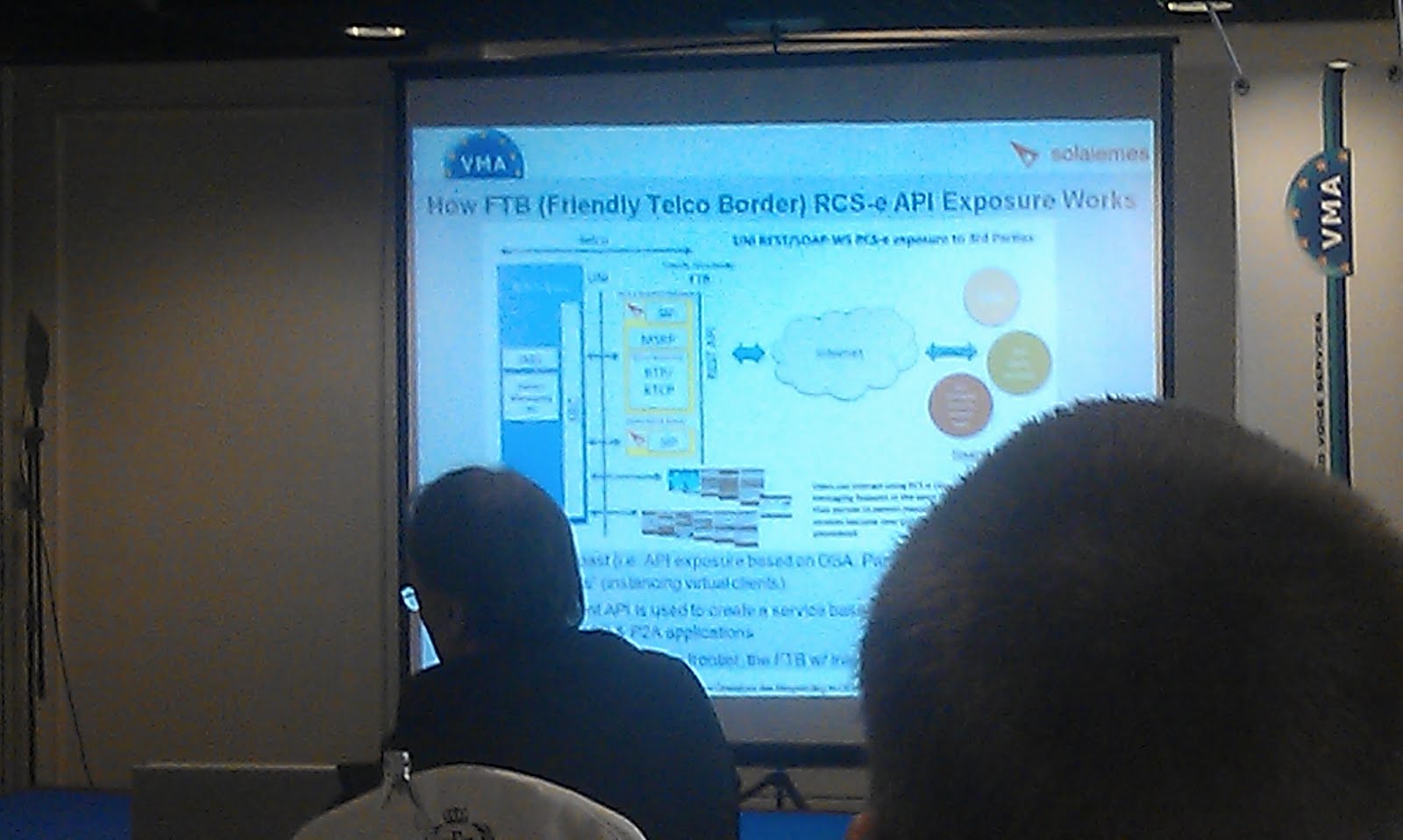
We attended the VMA conference

We attended the past 3 days the VMA (Voice & Messaging Association) conference in Madrid. Many representatives from telcos, network equipment vendors and also start-ups were there discussing about current and coming trends in voice and messaging space.
Particulary interesting  were the keynotes by telco representatives including Joyn/RCS-e as call completion alternative channel. We idenfied the immediate application of Joyn to the visual voice mail space.
Also, Ronald Gruía, a Frost&Sullivan analyst,  pointed that innovation is not coming from telcos or the big NEVs but the start-ups. Also he explained that telcos should evolve but can not try to become the same of internet companies as the business models are different.
I would add: telcos! evolve your soul, do not kill it.

We could pitch during the innovation contest explaining the FTB and how the RCS-e REST API exposure works and how it enables RCS-e/Joyn to become a service platform.
Congrats to the winner, a spanish startup Mobbeel developing amazing biometric technology for mobile services authentication.

It was a great conference with a great networking, thanks for the invite !!!